
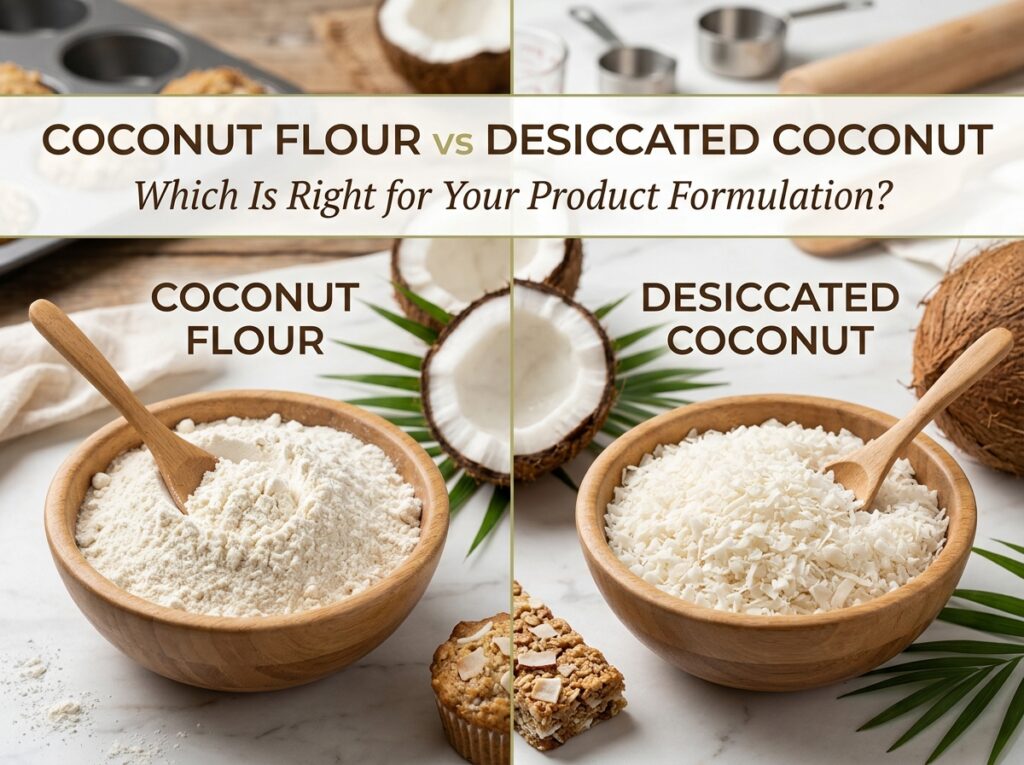
Coconut flour and desiccated coconut are both derived from the white flesh of the coconut — but they are fundamentally different ingredients with distinct nutritional profiles, functional properties, and manufacturing applications. Using the wrong one in a product formulation is a costly mistake, both in terms of finished product quality and procurement efficiency.
This guide is written specifically for food manufacturers, product developers, and procurement teams evaluating coconut-derived ingredients for new product development or existing formulation review. It covers the production differences, nutritional specifications, functional properties, and the manufacturing applications where each ingredient performs best.
How They Are Made: The Production Difference That Drives Everything
Understanding how coconut flour and desiccated coconut are produced explains almost every functional difference between them — and why substituting one for the other in a formulation rarely works without significant recipe adjustment.
How Desiccated Coconut Is Produced
Desiccated coconut is produced by removing the brown skin from fresh coconut flesh, then shredding or grinding the white flesh to a specified particle size, and drying it to a low moisture content — typically below 3%. The fat content of the original coconut flesh is retained almost entirely throughout this process, giving desiccated coconut its characteristic richness, flavour intensity, and high energy density.
The result is a high-fat, low-moisture ingredient that carries the full flavour, texture, and mouthfeel of coconut. It is available in multiple grades — fine, medium, coarse, chips, and shreds — each with different particle size, bulk density, and functional behaviour in finished products.
How Coconut Flour Is Produced
Coconut flour is a by-product of coconut milk or cream production. After coconut flesh is pressed to extract coconut milk, the remaining coconut solids — depleted of most of their fat and moisture — are dried and milled into a fine powder. This defatting process is the critical distinction: coconut flour contains significantly less fat than desiccated coconut and correspondingly much higher levels of dietary fibre.
The high fibre content of coconut flour — typically 38–45% dietary fibre by weight — gives it strong water absorption properties that make it behave very differently from desiccated coconut (and from wheat flour) in baked goods and other applications. A formulation designed for desiccated coconut cannot simply substitute coconut flour at the same ratio without substantial recipe reformulation.
Nutritional Profile Comparison
| Nutrient (per 100g) | Desiccated Coconut (standard) | Desiccated Coconut (low-fat) | Coconut Flour |
|---|---|---|---|
| Energy | ~660 kcal | ~380 kcal | ~400 kcal |
| Total fat | 62–65% | 6–8% | 10–14% |
| Saturated fat | 55–58% | 5–7% | 9–12% |
| Dietary fibre | 13–16% | 18–22% | 38–45% |
| Protein | 6–7% | 8–10% | 18–20% |
| Carbohydrate | 6–8% | 10–14% | 21–25% |
| Moisture | <3% | <3% | <12% |
| Flavour intensity | Strong coconut | Mild coconut | Mild to neutral |
Note: Specifications vary by supplier and production batch. Always request a full technical data sheet and certificate of analysis from your supplier before finalising formulation parameters.
Desiccated Coconut: Grades, Properties, and Manufacturing Applications
Desiccated coconut is not a single ingredient specification — it is a family of ingredients defined by particle size and fat content, each with meaningfully different functional behaviour in finished products. Selecting the right grade is as important as selecting the ingredient itself.
Standard Desiccated Coconut Grades
| Grade | Particle Size | Texture | Primary Manufacturing Application |
|---|---|---|---|
| Fine | 0.3–0.8mm | Soft, powdery | Coatings, fillings, biscuits, cakes, confectionery centres |
| Medium | 0.8–2.0mm | Slightly textured | Granola, cereal bars, muesli, bakery toppings, lamingtons |
| Coarse | 2.0–5.0mm | Visibly textured | Confectionery coatings, premium granola, trail mix, retail packs |
| Chips / shreds | 5.0–15mm | Large, irregular pieces | Chocolate inclusions, premium snack mixes, topping applications |
| Low-fat fine | 0.3–0.8mm | Soft, dry | Health food products, high-fibre formulations, reduced-calorie ranges |
Key Functional Properties of Desiccated Coconut
- Fat content drives mouthfeel: Standard desiccated coconut’s high fat content (62–65%) delivers richness and mouthfeel in finished products. This fat acts as a natural emollient in confectionery and bakery applications — contributing to texture without additional fat inputs.
- Low water activity: The low moisture content (<3%) gives desiccated coconut a long shelf life and makes it highly stable in dry blended products. It does not contribute meaningfully to the water activity of the finished product.
- Flavour contribution: Standard and medium grades carry strong, characteristic coconut flavour — a design feature in coconut-forward products but a consideration in formulations where coconut flavour should be background rather than dominant.
- Toasting behaviour: Desiccated coconut toasts predictably under dry heat — fine grades toast quickly and evenly, making them suitable for surface applications where a golden finish is required.
Coconut Flour: Properties and Manufacturing Applications
Coconut flour’s functional identity is defined by two properties above all others: its exceptional dietary fibre content and its very high water absorption capacity. These two characteristics determine both where it excels and where it fails as a formulation ingredient.
Key Functional Properties of Coconut Flour
- Water absorption: Coconut flour absorbs approximately 4–5 times its weight in water — significantly more than wheat flour (which absorbs roughly 0.6 times its weight). Any formulation substituting coconut flour for wheat flour at equal ratios will produce a dry, dense, crumbly product unless liquid ratios are substantially increased.
- High dietary fibre: At 38–45% dietary fibre, coconut flour is one of the highest-fibre flours available commercially. This makes it a valuable functional ingredient for manufacturers targeting high-fibre product claims — but the fibre content also contributes to the high water absorption that makes formulation challenging.
- Gluten-free: Coconut flour is naturally gluten-free and suitable for inclusion in certified gluten-free product ranges. It provides bulk in gluten-free formulations but requires binding agents (eggs, flaxseed, xanthan gum) to compensate for the absence of gluten’s structural properties.
- Mild flavour: The defatting process that produces coconut flour removes much of the coconut’s characteristic flavour. Coconut flour has a mild, slightly sweet, neutral flavour profile — making it suitable for formulations where coconut flavour is not a design goal.
- Protein content: At 18–20% protein, coconut flour contributes meaningfully to the protein content of finished products — a useful attribute for manufacturers developing high-protein ranges.
Primary Manufacturing Applications for Coconut Flour
- Gluten-free bakery: Biscuits, cakes, muffins, and bread where gluten-free certification is required. Typically used at 20–30% substitution of wheat flour, with liquid ratios adjusted upward to compensate for absorption.
- High-fibre product ranges: Protein bars, cereal bars, and functional snacks where a high dietary fibre claim is a product positioning requirement.
- Dry blend ingredients: Meal replacement powders, protein blends, and functional food mixes where coconut flour contributes fibre, mild flavour, and bulk.
- Thickening applications: Coconut flour’s high fibre and absorption properties can serve a thickening function in dry sauce mixes and seasoning blends — absorbing moisture during rehydration and contributing body to the finished dish.
Head-to-Head: Which Ingredient for Which Application?
| Manufacturing Application | Best Choice | Reason |
|---|---|---|
| Coconut-flavoured confectionery coating | Desiccated coconut (fine or medium) | Fat content and flavour are design features; texture toasts well |
| Granola and cereal bars | Desiccated coconut (medium or coarse) | Visible texture, toasting colour, and coconut flavour all contribute to product |
| Gluten-free biscuit or cake | Coconut flour | Gluten-free certification; fibre content; neutral flavour integrates well |
| High-fibre protein bar | Coconut flour | High fibre claim; protein contribution; absorbs binding agents well |
| Reduced-calorie coconut product | Low-fat desiccated coconut | Retains coconut flavour and texture with significantly reduced fat and calories |
| Premium chocolate inclusion | Desiccated coconut (chips/shreds) | Large particle size creates visual and textural differentiation |
| Meal replacement powder blend | Coconut flour | Fine powder integrates cleanly; fibre and protein contribution; mild flavour |
| Muesli or trail mix | Desiccated coconut (medium or coarse) | Textural contrast and coconut flavour are expected product attributes |
| Dry seasoning or sauce mix | Coconut flour | Absorption properties useful in dry rehydratable formats |
| Lamington or coconut roll coating | Desiccated coconut (fine or medium) | Traditional application — texture and flavour are the product’s defining characteristic |
Bulk Supply: Formats, MOQ, and Packaging
Both desiccated coconut and coconut flour are available for bulk B2B supply from Sri Lanka in standardised export packaging formats suited to food manufacturing environments:
Desiccated Coconut — Bulk Supply Formats
- 25kg kraft paper bags (inner PE liner) — standard export format for all grades
- 50lb polypropylene bags — available for specific export markets
- Retail consumer packs (200g–500g) available for private label programmes
- Full Container Load (FCL): approximately 18–20 metric tonnes per 20-foot container
- All grades — fine, medium, coarse, chips, low-fat — available in FCL and LCL quantities
Coconut Flour — Bulk Supply Formats
- 25kg kraft paper bags (inner PE liner) — standard export format
- Full Container Load (FCL): approximately 18–20 metric tonnes per 20-foot container
- LCL (Less than Container Load) consolidation available for smaller volumes
Both products are available with EU Organic, Fairtrade, Halal, Kosher, and BRC certification. Certificates of analysis — covering moisture, fat content, dietary fibre, microbiological parameters, aflatoxin, and MRL residue testing — are provided with every production batch.
Sourcing Desiccated Coconut and Coconut Flour from Navik Mills
Navik Mills (Pvt) Ltd manufactures and exports desiccated coconut in all grades and coconut flour from Sri Lanka, supplying food manufacturers, ingredient distributors, and retail brands across 35+ countries. Our ingredient supply for food manufacturing buyers includes:
- Desiccated coconut: fine, medium, coarse, chips/shreds, and low-fat grades
- Coconut flour: standard and organic certified specifications
- EU Organic, Fairtrade, Halal, Kosher, and BRC certification across both product lines
- Full technical data sheets, certificates of analysis, and batch traceability for every order
- Private label retail packaging available for desiccated coconut in all grades
- GSP+ origin documentation for 0% EU import duty on all eligible product lines
Ready to request specifications or samples for your formulation project? Contact our export team to discuss your ingredient requirements, MOQ, and certification needs.
Frequently Asked Questions
Can coconut flour be substituted for desiccated coconut in a recipe or formulation?
Not directly. Coconut flour and desiccated coconut have fundamentally different fat contents, moisture absorption properties, and functional behaviour. Coconut flour absorbs approximately 4–5 times its weight in water, while desiccated coconut absorbs very little liquid. Substituting one for the other at equal ratios will produce a significantly different finished product — typically dry and dense when coconut flour replaces desiccated coconut without adjusting liquid ratios. They should be treated as distinct ingredients requiring separate formulation development.
What is low-fat desiccated coconut and when should food manufacturers use it?
Low-fat desiccated coconut is produced by mechanically pressing standard desiccated coconut to remove most of its natural fat content, reducing fat from approximately 62–65% to 6–8%. The result is a lighter, drier ingredient with a significantly reduced calorie content but a similar particle size and mild coconut flavour compared to standard grades. It is primarily used in health food products, high-fibre formulations, and reduced-calorie ranges where coconut texture and flavour are desired without the full fat contribution of standard desiccated coconut.
Is coconut flour gluten-free and suitable for certified gluten-free product manufacturing?
Yes. Coconut flour is naturally gluten-free and is widely used in certified gluten-free product formulations. When sourcing coconut flour for gluten-free manufacturing, confirm with your supplier that the product is processed in a dedicated gluten-free facility or that appropriate allergen segregation controls are in place — cross-contamination risk from shared processing lines is a compliance consideration for certified gluten-free claims.
Which desiccated coconut grade is best for granola and cereal bar manufacturing?
Medium grade desiccated coconut (0.8–2.0mm particle size) is the most common choice for granola and cereal bar applications — it provides visible coconut texture, toasts evenly in an oven or drum roaster, and delivers characteristic coconut flavour without the bulkiness of coarse grade. Coarse grade is preferred where a more prominent visual coconut presence is a product design requirement, such as in premium granola or trail mix formulations.
Does desiccated coconut from Sri Lanka qualify for 0% EU import duty?
Yes. Desiccated coconut (HS code 0801.11) from Sri Lanka qualifies for 0% EU import duty under both the standard EU MFN rate and Sri Lanka’s GSP+ status. Coconut flour also qualifies for preferential GSP+ duty treatment. Navik Mills provides full GSP+ origin documentation — GSP Form A or REX Statement of Origin — as standard with all EU export orders.
