
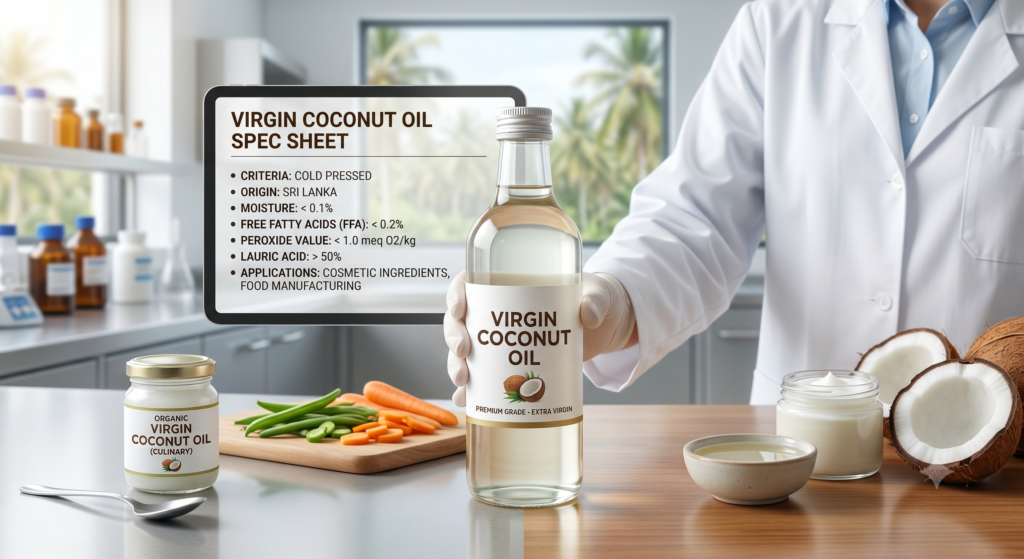
Virgin coconut oil (VCO) has become one of the most commercially valuable coconut derivatives in the world. The global VCO-based cosmetics market alone is valued at over $2.9 billion in 2025, while food-grade VCO continues to grow as a premium cooking oil, nutraceutical ingredient, and MCT source for functional foods.
For food manufacturers and cosmetics formulators sourcing VCO at scale, the procurement decision comes down to measurable specifications: fatty acid composition, free fatty acid content, moisture levels, extraction method, and certification compliance. This article provides the complete technical spec sheet that B2B buyers need to evaluate a virgin coconut oil supplier — whether you are formulating skincare products, cooking oils, or functional food ingredients.
What Makes Virgin Coconut Oil Different from Refined Coconut Oil?
Not all coconut oil is the same. The distinction between virgin and refined coconut oil is critical for B2B buyers because it determines product quality, regulatory classification, and end-use suitability.
| Parameter | Virgin Coconut Oil (VCO) | Refined Coconut Oil (RBD) |
|---|---|---|
| Raw material | Fresh coconut meat or fresh coconut milk | Dried copra (sun-dried or kiln-dried coconut meat) |
| Extraction method | Cold-pressed or centrifuge — no chemicals | Solvent extraction, then refined, bleached, deodorised |
| Aroma & flavour | Natural coconut aroma and mild flavour | Neutral — no coconut scent or taste |
| Colour | Water-clear (liquid) or snow-white (solid) | Clear to pale yellow |
| Nutrient retention | High — retains polyphenols, vitamin E, antioxidants | Low — most bioactives destroyed during refining |
| Free fatty acid (FFA) | <0.2% (premium grade) | <0.1% (post-refining) |
| Smoke point | ~177°C (350°F) | ~204°C (400°F) |
| Best for | Premium skincare, nutraceuticals, functional foods, clean-label cooking oils | Industrial food processing, frying, soap manufacturing |
Navik Mills produces both virgin coconut oil and refined coconut oil in organic certified formats, giving B2B buyers access to both grades from a single vertically integrated supplier.
Fatty Acid Profile: The Specification That Matters Most
The commercial value of virgin coconut oil is driven by its fatty acid composition — specifically its exceptionally high lauric acid content and medium-chain triglyceride (MCT) concentration. Here is the typical fatty acid profile of Sri Lankan VCO:
| Fatty Acid | Carbon Chain | Typical % | Significance |
|---|---|---|---|
| Lauric Acid | C12:0 | 45–52% | Antimicrobial, antifungal — the key value driver for cosmetics and nutraceuticals |
| Myristic Acid | C14:0 | 16–21% | Emollient properties — valued in skincare formulations |
| Caprylic Acid | C8:0 | 5–8% | Rapid energy MCT — highly valued in keto and functional food products |
| Capric Acid | C10:0 | 5–7% | Antimicrobial MCT — valued in both food and cosmetic applications |
| Palmitic Acid | C16:0 | 7–10% | Structural fatty acid — contributes to oil stability |
| Oleic Acid | C18:1 | 5–10% | Monounsaturated — skin penetration enhancer in cosmetics |
| Stearic Acid | C18:0 | 2–4% | Emulsifier and thickener in cosmetic formulations |
| Caproic Acid | C6:0 | 0.4–0.6% | Short-chain — contributes to antimicrobial activity |
Total MCT content (C6–C12): approximately 62% — making VCO one of the richest natural sources of medium-chain triglycerides available to food and cosmetic manufacturers.
Food-Grade vs Cosmetic-Grade VCO: What B2B Buyers Need to Know
A common question from procurement teams: is there a difference between food-grade and cosmetic-grade virgin coconut oil?
The short answer: the oil itself is often identical. High-quality, cold-pressed virgin coconut oil meets the requirements for both food and cosmetic applications. The difference lies in the regulatory framework, testing protocols, and documentation that the supplier provides.
Food-Grade VCO Requirements
- Must comply with Codex Alimentarius standards for edible coconut oil
- Requires HACCP, ISO 22000, or FSSC 22000 food safety certification
- Full nutritional panel per 100g required for retail labelling
- Allergen declarations mandatory in EU and US markets
- Organic claims require USDA NOP or EU Organic certification
Cosmetic-Grade VCO Requirements
- Must comply with EU Cosmetic Regulation (EC 1223/2009) or FDA cosmetic guidelines
- Requires GMP certification specific to cosmetic manufacturing (ISO 22716)
- Heavy metals testing (lead, arsenic, cadmium, mercury) below cosmetic thresholds
- Microbiological testing specific to leave-on vs rinse-off formulations
- INCI name declaration: Cocos Nucifera (Coconut) Oil
A supplier like Navik Mills that holds BRC, HACCP, GMP, and organic certifications can supply VCO that meets both food and cosmetic regulatory requirements from the same production facility.
Applications: How Manufacturers Use VCO
Food & Nutraceutical Applications
| Application | Why VCO Is Used | Key Spec Requirement |
|---|---|---|
| Premium cooking oil | Clean-label, natural coconut aroma, medium smoke point | FFA <0.2%, organic certified |
| MCT oil base / keto products | 62% total MCT content — highest natural MCT source | Detailed fatty acid COA (C8, C10, C12 breakdown) |
| Functional food ingredient | Added to smoothies, protein bars, energy balls | Organic + allergen-free documentation |
| Dairy-free butter/spread | Solid at room temp, natural white colour, clean taste | Melting point 24–26°C, colour consistency |
| Confectionery coating | Sharp melting point, glossy finish, no trans fats | Iodine value, slip melting point |
| Infant nutrition base | Lauric acid mimics breast milk fatty acid profile | Pharmaceutical-grade purity, heavy metals testing |
Cosmetics & Personal Care Applications
| Application | Why VCO Is Used | Key Spec Requirement |
|---|---|---|
| Moisturisers & body lotions | Deep skin penetration, non-greasy emollient, antimicrobial | Peroxide value <1, moisture <0.1% |
| Hair oils & conditioners | Penetrates hair shaft, reduces protein loss, natural shine | Low FFA, cold-pressed extraction |
| Lip balms & lip care | Natural emollient with pleasant coconut flavour | Food-grade purity (lip products are ingested) |
| Soap and cleanser base | High lauric acid creates rich, stable lather | Saponification value 250–264 |
| Massage oils | Excellent skin slip, natural scent, hypoallergenic | Cosmetic-grade micro testing |
| Sun care formulations | Natural mild UV filtering (~SPF 4–5), skin conditioning | Stability testing, photo-oxidation resistance |
Navik Mills VCO Product Range
Navik Mills produces the following coconut oil variants, all available in bulk and retail formats:
- Organic Extra Virgin Coconut Oil — cold-pressed from fresh coconut meat, premium grade
- Organic Virgin Coconut Oil — standard VCO for food and cosmetic applications
- Organic White Coconut Oil — refined, bleached, deodorised for neutral-scent applications
- Organic Coconut Oil — standard organic grade for food processing
- Refined Coconut Oil — RBD grade for industrial food and soap manufacturing
- Flavoured Virgin Coconut Oils — infused with vanilla, cinnamon, turmeric, chilli, and black pepper
Bulk Formats Available
| Format | Volume | Best For |
|---|---|---|
| Steel drums | 190 kg / 200 litres | Mid-scale food and cosmetic manufacturing |
| IBC totes | 1,000 litres | High-volume production lines |
| Flexi-bags in container | 20,000 litres (20 MT) | Large-scale industrial buyers |
| Glass jars / PET bottles | 200mL – 1L | Retail and private label |
Quality Parameters: Your Pre-Order Checklist
Before placing a bulk VCO order, request the following documentation and verify these parameters:
| Test | Acceptable Range (Premium VCO) | What It Tells You |
|---|---|---|
| Free Fatty Acid (FFA) | <0.2% | Oil freshness and extraction quality — lower is better |
| Moisture content | <0.1% | Storage stability — excess moisture causes rancidity |
| Peroxide value | <3 meq/kg | Oxidation level — indicates freshness and storage conditions |
| Iodine value | 4.1–11.0 | Degree of unsaturation — affects melting behaviour |
| Saponification value | 250–264 | Critical for soap manufacturers — determines lather quality |
| Colour (Lovibond) | Clear to water-white | Visual quality indicator — premium VCO is crystal clear when liquid |
| Melting point | 24–26°C | Solid below, liquid above — important for formulation consistency |
| Total plate count | <10 CFU/g | Microbial safety — essential for cosmetic applications |
Why Source VCO from Sri Lanka?
Sri Lanka offers specific advantages for VCO sourcing that differentiate it from the Philippines and Indonesia:
- Smallholder organic base — 80%+ of coconuts come from farms using minimal synthetic inputs, ensuring genuinely clean raw material
- Cold-press expertise — Sri Lankan manufacturers have invested heavily in cold-press and centrifuge extraction technology
- Full certification stack — BRC, USDA Organic, EU Organic, Fair Trade, Halal, Kosher from a single source
- No monkey labour — Sri Lankan producers guarantee ethical harvesting with properly compensated human labour
- Flavoured VCO innovation — unique product line including vanilla, cinnamon, turmeric, chilli, and black pepper infusions
Request VCO Samples & Pricing →
Frequently Asked Questions
What is the difference between virgin coconut oil and extra virgin coconut oil?
Unlike olive oil, there is no internationally regulated distinction between “virgin” and “extra virgin” coconut oil. Both are cold-pressed from fresh coconut meat without chemical processing. In practice, “extra virgin” typically indicates the first cold pressing with the lowest free fatty acid content (<0.1%), while “virgin” may include subsequent pressings with slightly higher FFA (<0.2%). Both are premium grades suitable for food and cosmetic applications.
Can the same virgin coconut oil be used for food and cosmetics?
Yes. High-quality cold-pressed VCO meets the compositional requirements for both food and cosmetic applications. The difference lies in regulatory documentation — food-grade VCO requires HACCP/ISO 22000 certification and nutritional labelling, while cosmetic-grade requires GMP (ISO 22716) certification and INCI declarations. A supplier with both certifications can supply from the same production batch.
Why is lauric acid content important in virgin coconut oil?
Lauric acid (C12) is the primary value driver of VCO. At 45–52% concentration, it provides antimicrobial and antifungal properties critical for cosmetic formulations, and MCT-related metabolic benefits valued in functional food products. It also mimics the fatty acid profile of human breast milk, making VCO a key ingredient in infant nutrition formulations. Higher lauric acid content generally indicates higher quality raw material and extraction.
What bulk formats are available for virgin coconut oil?
VCO is available in steel drums (190 kg), IBC totes (1,000 litres), flexi-bags in container (20 MT), and retail formats (glass jars, PET bottles from 200mL to 1L). Format selection depends on your production volume, storage capacity, and whether you are repacking for retail or using VCO as an industrial ingredient.
What certifications should a VCO supplier have?
For food applications: BRC or FSSC 22000, HACCP, USDA NOP Organic, EU Organic, Halal, and Kosher. For cosmetic applications: add GMP (ISO 22716). For ethical sourcing: Fair Trade and SMETA/SEDEX. Navik Mills holds the complete certification stack for both food and cosmetic supply.
