
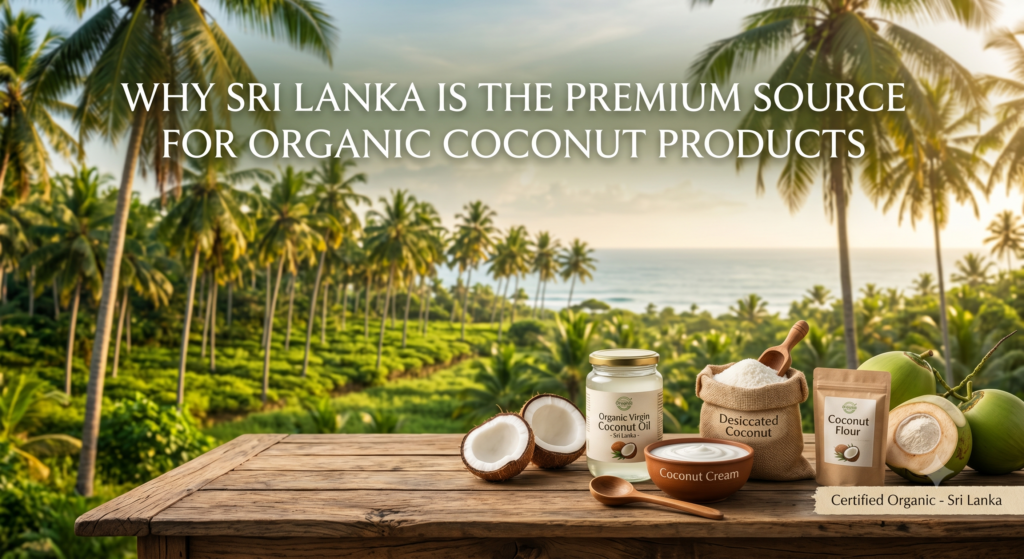
If you are sourcing organic coconut products for your brand, food manufacturing line, or retail distribution, the origin of your supply chain matters more than most buyers realise. The country where your coconuts are grown, processed, and certified directly affects product quality, regulatory compliance, shelf stability, and your customers’ trust.
Sri Lanka has been at the centre of the global coconut trade for over a century. Today, it ranks as the world’s fourth-largest coconut producer — and first in the category that matters most to B2B buyers: premium, certified, value-added coconut products.
This article explains exactly why Sri Lanka holds that position, what makes its organic coconut products superior, and what importers and food manufacturers should look for when choosing a Sri Lankan supplier.
The Coconut Triangle: Where Quality Begins
Sri Lanka’s coconut industry is concentrated in a region known as the Coconut Triangle — spanning the districts of Kurunegala, Puttalam, and Gampaha along the island’s western and north-western coast.
This region produces the majority of Sri Lanka’s annual coconut harvest thanks to a rare combination of natural advantages:
- Tropical climate with consistent rainfall patterns — optimal humidity and temperature year-round ensure steady palm growth and high-yield harvests.
- Fertile, well-drained laterite soils — the mineral-rich coastal and inland soils of the Coconut Triangle produce coconuts with higher oil content, richer flavour profiles, and the fine white colour that premium buyers demand.
- Established palm estates with generational expertise — many coconut estates in this region have been cultivated for decades, managed by farming families with deep knowledge of sustainable palm care.
The result is a raw material — the Sri Lankan coconut — that consistently outperforms competitors from the Philippines, Indonesia, and Thailand on the quality metrics that food manufacturers and retailers care about most: fat content, colour, texture, and taste.
Sri Lanka’s Organic Advantage: Naturally Clean Agriculture
One of the most significant — and least understood — advantages of sourcing from Sri Lanka is that over 80% of the country’s coconut production comes from smallholder farms that use little to no synthetic fertilisers, insecticides, or weedicides.
This means that a vast proportion of Sri Lanka’s coconut supply is effectively organic by practice, even before formal certification. For processors and exporters like Navik Mills, this creates a reliable upstream supply of genuinely clean raw material — something that larger producing countries with industrial-scale plantation models often struggle to guarantee.
What This Means for B2B Buyers
- Lower contamination risk — fewer chemical inputs at the farm level means fewer residues to manage during processing and testing.
- Easier organic certification pathways — farms converting to certified organic status face shorter transition periods because their baseline practices already align with organic standards.
- Authentic “organic” positioning — your product labels aren’t just technically compliant; they reflect a genuinely clean agricultural tradition that resonates with end consumers.
Product Range: From Whole Coconut to 300+ Value-Added SKUs
Sri Lanka’s coconut industry has evolved far beyond raw copra and crude oil exports. Today, leading manufacturers offer an extraordinary range of value-added products that serve virtually every segment of the global food, beverage, and cosmetics market.
Navik Mills, for example, produces over 300 certified organic coconut products across the following categories:
| Product Category | Key Formats | Typical B2B Applications |
|---|---|---|
| Coconut Milk | Canned (6–20% fat), aseptic (20L, 200L, 1000L), powder | Food service, RTD beverages, dairy alternatives |
| Coconut Cream | Canned (22%, 30% fat), aseptic bulk | Confectionery, ice cream bases, cooking sauces |
| Desiccated Coconut | Fine, medium, coarse, low-fat | Bakery, snack bars, breakfast cereals |
| Virgin Coconut Oil | Cold-pressed, refined, flavoured | Cosmetics, nutraceuticals, cooking oils |
| Coconut Water | King coconut, standard, flavoured | RTD beverages, sports drinks, functional foods |
| Coconut Sugar | Granulated, liquid | Natural sweetener replacement, baking |
| Coconut Butter | Smooth, creamed coconut | Spreads, confectionery, vegan products |
| Coconut Amino | Sauce, teriyaki, garlic, glaze | Soy sauce alternative, marinades, clean-label condiments |
This breadth of product range means B2B buyers can consolidate their coconut ingredient sourcing with a single Sri Lankan supplier — reducing logistics complexity, simplifying certification audits, and achieving better pricing through volume.
The Certification Stack: What Sri Lankan Exporters Bring to the Table
Access to premium retail shelves in Europe, North America, Japan, and the Middle East requires a specific combination of food safety, organic, ethical, and religious certifications. Sri Lanka’s leading coconut exporters maintain one of the most comprehensive certification portfolios in the global food ingredient industry.
Food Safety & Quality
- BRCGS (British Retail Consortium Global Standards) — the gold standard for UK and international retail supply chains. BRC certification is often a non-negotiable requirement for major supermarket chains.
- FSSC 22000 / ISO 22000 / HACCP — internationally recognised food safety management systems that prove your supplier operates under rigorous process controls.
- GMP (Good Manufacturing Practices) — foundational hygiene and processing standards.
Organic Certifications
- USDA NOP — required for the North American organic market.
- EU Organic (EC 2018/848) — mandatory for European organic product claims.
- JAS (Japanese Agricultural Standards) — essential for the Japanese market.
Ethical & Social Certifications
- Fair Trade — verifies ethical sourcing, fair wages, and improved conditions for farming communities.
- SMETA / SEDEX — social compliance auditing for supply chain transparency.
- Rainforest Alliance — sustainability and environmental responsibility verification.
Religious & Dietary
- Halal — critical for Middle Eastern and South-East Asian markets.
- Kosher — required for specific retail and food service channels.
- Vegan — increasingly important for plant-based product positioning.
A supplier like Navik Mills that holds this full certification stack eliminates one of the most time-consuming barriers to market entry for B2B buyers: the certification audit.
Sri Lanka’s Export Track Record: $1.2 Billion and Growing
Sri Lanka’s strategic pivot toward value-added coconut products is not a future aspiration — it is a proven, measurable reality.
In 2025, Sri Lanka’s coconut sector generated approximately $1.23 billion in export revenue, a 43% increase over 2024. This growth was driven entirely by demand for processed, certified products — coconut milk, cream, virgin coconut oil, desiccated coconut, and coconut water — rather than raw commodity exports.
The industry’s target is $2.5 billion in annual coconut exports by 2030, supported by government investment in replanting programmes, fertiliser subsidies for smallholder farmers, and the development of the Northern Coconut Triangle to expand production capacity.
For B2B buyers, this trajectory signals three important things:
- Supply security — Sri Lanka is actively investing in long-term production capacity, not just current output.
- Processing infrastructure — the country’s manufacturing base is scaling to meet growing international demand for value-added products.
- Competitive pricing — increased volume and government support are keeping Sri Lankan coconut products cost-competitive against alternative origins.
What Sets Sri Lanka Apart from the Philippines, Indonesia, and Thailand?
| Factor | Sri Lanka | Philippines | Indonesia | Thailand |
|---|---|---|---|---|
| Desiccated coconut quality | World’s finest — fine texture, white colour, rich flavour | Good quality but less consistent | Variable quality | Limited production |
| Organic farming base | 80%+ smallholder, naturally low-chemical | Mixed — large plantations use more inputs | Industrial-scale, higher chemical use | Smaller coconut sector |
| Certification depth | Full stack: BRC, Organic, Fair Trade, Halal, Kosher | Strong on organic, weaker on BRC | Improving but inconsistent | Limited B2B focus |
| Product range | 300+ value-added SKUs | Strong in VCO, limited in specialty | Strong in crude oil, growing in milk | Niche |
| B2B export focus | Primary focus — private label, bulk, food ingredient | Mixed B2C/B2B | Commodity-heavy | B2C-dominant |
| Ethical sourcing | No monkey labour, Fair Trade, CSR programmes | Monkey labour concerns in some regions | Less transparency | Monkey labour controversies |
| King coconut | Exclusive to Sri Lanka — premium coconut water | Not available | Not available | Not available |
A critical differentiator: Sri Lanka is the only commercial source of King coconut (Cocos nucifera var. aurantiaca), a naturally sweeter, more nutrient-dense variety that produces premium coconut water. This gives Sri Lankan suppliers an exclusive product that cannot be sourced from any other origin.
How to Evaluate a Sri Lankan Coconut Supplier
If you are considering Sri Lanka as your coconut product source, here is a practical checklist for evaluating potential suppliers:
- Verify certifications directly — request copies of current BRC, organic, and Fair Trade certificates. Check expiry dates and scope of certification.
- Ask about vertical integration — does the supplier control the supply chain from farm to finished product, or are they a trading intermediary?
- Request product specification sheets — fat percentages, Brix levels, pH, shelf life, and packaging formats should be documented and consistent.
- Check private label capability — can the supplier produce under your brand, with your formulation, in your packaging format?
- Confirm MOQ and lead times — bulk aseptic (20L, 200L, 1000L), canned, retail, and powder formats all have different minimums.
- Visit the facility — or request a virtual factory tour. Look for BRC-grade processing environments, not just certificates.
- Assess ethical practices — confirm no monkey labour, confirm Fair Trade participation, ask about CSR programmes and community impact.
Conclusion: Why B2B Buyers Are Choosing Sri Lanka
Sri Lanka’s position as the world’s premium source for organic coconut products is not based on marketing — it is based on measurable advantages in raw material quality, certification depth, product range, and ethical sourcing practices.
For importers, food manufacturers, private label brands, and distributors looking for a reliable, certified, and competitively priced organic coconut product supplier, Sri Lanka should be the first origin you evaluate — and a vertically integrated manufacturer like Navik Mills should be on your shortlist.
Request a Quote from Navik Mills →
Frequently Asked Questions
Why is Sri Lanka considered the best source for organic coconut products?
Sri Lanka combines superior raw material quality from the Coconut Triangle region, a naturally organic smallholder farming base (80%+ of production), world-leading desiccated coconut quality, and the deepest certification stack in the industry — including BRC, USDA Organic, EU Organic, Fair Trade, Halal, and Kosher. These factors make it the preferred origin for B2B buyers sourcing premium organic coconut ingredients.
What organic coconut products does Sri Lanka export?
Sri Lanka exports a comprehensive range of value-added organic coconut products including coconut milk (canned and aseptic), coconut cream, desiccated coconut (fine, medium, coarse, low-fat), virgin coconut oil, coconut water (including exclusive King coconut water), coconut sugar, coconut flour, coconut butter, coconut amino, coconut milk powder, and coconut cream in bulk formats.
How does Sri Lanka compare to the Philippines and Indonesia for coconut sourcing?
While the Philippines and Indonesia produce larger volumes of raw coconuts, Sri Lanka leads in value-added product quality, certification compliance, and B2B export focus. Sri Lankan desiccated coconut is widely regarded as the finest in the world, and the country’s manufacturers hold more comprehensive certification portfolios (BRC, Organic, Fair Trade) than most competitors. Sri Lanka is also the only source of King coconut water.
Is coconut harvesting in Sri Lanka ethical?
Yes. Leading Sri Lankan exporters like Navik Mills explicitly guarantee no monkey labour is used in coconut harvesting — a concern that has affected suppliers in Thailand and some parts of the Philippines. Sri Lankan producers use properly compensated human labour, participate in Fair Trade programmes, and invest in community development through active CSR initiatives.
What certifications should I look for in a Sri Lankan coconut supplier?
Look for BRC (or FSSC 22000) for food safety, USDA NOP and EU Organic for organic compliance, Fair Trade for ethical sourcing, and Halal/Kosher for market-specific requirements. A supplier with the full certification stack — like Navik Mills — simplifies your compliance process and gives you access to all major international markets from a single source.
