
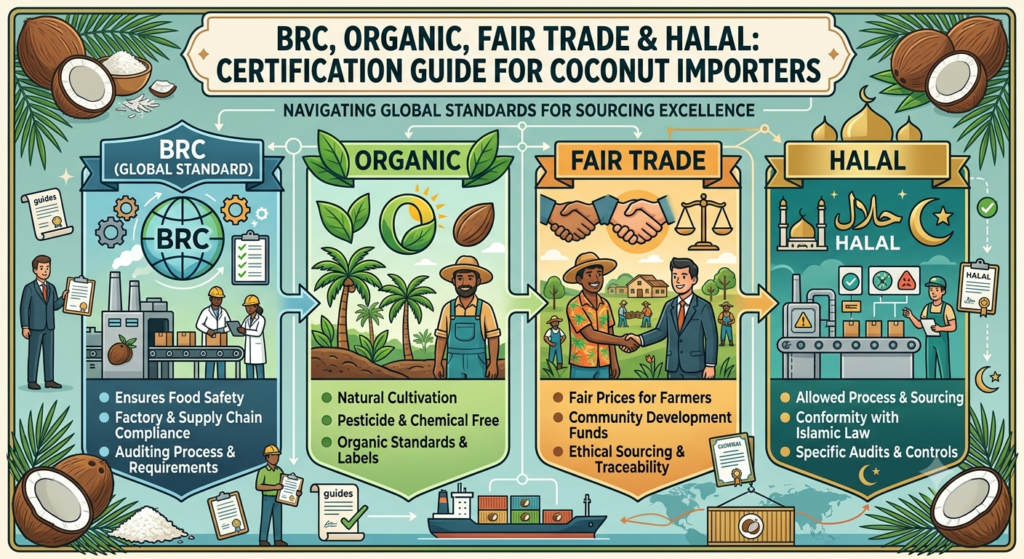
If you are importing coconut products for retail, food manufacturing, or private label distribution, your supplier’s certification portfolio is not a nice-to-have — it is the gatekeeper to every market you want to enter. Without the right certifications, your products cannot legally be sold as organic, cannot be listed by major retailers, and cannot access religious dietary markets worth billions of dollars.
Yet many B2B buyers — especially first-time importers — struggle to understand what each certification actually verifies, which ones they need for their specific market, and how to verify that a supplier’s certificates are legitimate and current.
This guide breaks down every major certification relevant to coconut product importers: what it covers, who requires it, and how to verify it. We will use Navik Mills’ certification portfolio as a real-world example of what a fully certified coconut products supplier looks like.
The Certification Stack: Why One Certificate Is Never Enough
No single certification covers all the requirements for international coconut product trade. Instead, importers need to think in terms of a certification stack — a combination of food safety, organic, ethical, and religious certifications that together unlock maximum market access.
| Certification Category | What It Covers | Who Requires It |
|---|---|---|
| Food Safety | Hygiene, HACCP, process control, traceability | Every retailer, every market — non-negotiable |
| Organic | No synthetic inputs, certified organic supply chain | Any product labelled or marketed as “organic” |
| Ethical / Social | Fair wages, working conditions, community impact | European retailers, conscious consumer brands |
| Religious / Dietary | Compliance with Islamic, Jewish, or vegan dietary laws | Middle Eastern, South-East Asian, and niche Western markets |
| Environmental | Sustainable practices, carbon footprint, waste management | EU regulatory compliance, sustainability-focused brands |
A supplier with the complete stack — like Navik Mills — allows you to access every major international market from a single source, without needing to qualify multiple suppliers for different certifications.
BRCGS: The Retail Gatekeeper
Full name: British Retail Consortium Global Standards (formerly BRC)
What it certifies: Food safety management systems, hygiene, process control, traceability
Who requires it: Tesco, Sainsbury’s, Aldi, Lidl, Carrefour, Walmart, and virtually every major international retail chain
Why BRC Matters for Coconut Importers
BRCGS is the single most important certification for any coconut product supplier targeting European and UK retail markets. Without it, your products will be rejected by procurement teams before they even review your samples.
BRC audits are conducted annually by accredited third-party auditors who inspect the entire manufacturing facility, from raw material intake through processing, packaging, storage, and dispatch. The audit covers over 300 requirements across these areas:
- HACCP-based food safety management system
- Quality management and continuous improvement
- Factory environment — layout, product flow, equipment maintenance
- Product control — allergen management, foreign body detection, weight control
- Process control — critical control points, monitoring, corrective actions
- Personnel — hygiene, training, protective clothing, health screening
Understanding BRC Grades
| Grade | What It Means | Implication for Buyers |
|---|---|---|
| AA / AA+ | Highest grade — exceptional compliance, minimal non-conformances | Lowest risk supplier. The “+” means the audit was unannounced. |
| A / A+ | Very high compliance — minor non-conformances only | Excellent supplier. Meets all major retailer requirements. |
| B / B+ | Acceptable compliance — some non-conformances noted | Acceptable for most channels, but may require additional buyer audits. |
| C / C+ or D | Significant non-conformances | High risk. Most retailers will not accept. Avoid. |
Tip for buyers: Always ask for the BRC grade, not just confirmation of certification. A Grade AA supplier and a Grade C supplier both “have BRC” — but the risk profiles are vastly different.
Organic Certifications: Three Standards, Three Markets
There is no single “organic” certification that covers the entire world. Instead, each major market has its own organic standard. To legally label and sell coconut products as “organic,” you need the specific certification for each market you are targeting.
USDA NOP (National Organic Program)
Market: United States, Canada
Governing body: U.S. Department of Agriculture
What it verifies: Products are produced without synthetic fertilisers, pesticides, GMOs, or ionising radiation. Organic integrity is maintained through the entire supply chain.
EU Organic (EC 2018/848)
Market: All European Union member states, plus UK (mutual recognition)
Governing body: European Commission
What it verifies: Climate and environmental protection, soil fertility, biodiversity conservation. Stricter than many national standards on processing aids and additives.
JAS Organic (Japanese Agricultural Standards)
Market: Japan
Governing body: Japanese Ministry of Agriculture, Forestry and Fisheries
What it verifies: Similar to USDA/EU but with Japan-specific requirements on production methods, labelling, and import documentation.
Naturland
Market: Germany and Central Europe (premium tier)
Governing body: Naturland – German Association for Organic Agriculture
What it verifies: Goes beyond EU Organic minimum requirements — covers social responsibility, fair trade principles, and additional environmental standards. Highly valued by German retail chains.
Navik Mills holds all four organic certifications — USDA NOP, EU Organic, JAS, and Naturland — covering every major organic market from a single supplier.
Fair Trade: The Ethical Sourcing Standard
What it certifies: Fair prices to farmers, decent working conditions, community development investment, environmental sustainability
Who requires it: European retailers increasingly require or prefer Fair Trade certification. Brands targeting conscious consumers use it as a key differentiator.
What Fair Trade Means in Practice for Coconut Products
- Premium payments — farmers receive a guaranteed minimum price plus a Fair Trade premium for community investment
- No child labour or forced labour — independently audited and verified
- Environmental standards — restrictions on chemical use, requirements for waste management and water conservation
- Community development — the Fair Trade premium must be invested in education, healthcare, infrastructure, or agricultural improvement
- Supply chain transparency — every transaction from farm to export is documented and auditable
Fair Trade Certification Bodies
| Body | Scope | Recognition |
|---|---|---|
| FairTSA | Fair Trade Sustainability Alliance — comprehensive fair trade and sustainability standard | Widely recognised in Europe and North America |
| FLOCERT | Certifier for Fairtrade International standards | The most widely recognised Fair Trade certifier globally |
Navik Mills holds FairTSA certification, with Fair Trade practices independently audited across their coconut supply chain from smallholder farms to export facility.
Halal & Kosher: Religious Dietary Compliance
Halal Certification
What it certifies: Products are permissible under Islamic law — no alcohol, no pork-derived ingredients, no cross-contamination with haram (forbidden) substances
Markets: Middle East, South-East Asia (Malaysia, Indonesia), growing Muslim populations in Europe and North America
Why it matters for coconut products: While coconut itself is halal, the processing facility must be certified — shared equipment, cleaning agents, and processing aids must all comply. Halal certification verifies the entire production environment, not just the ingredient.
Kosher Certification
What it certifies: Products comply with Jewish dietary laws (Kashrut) — verified by a Rabbi and certified by an authorised Kosher agency
Markets: United States (large Jewish population), Israel, Jewish communities in UK, France, Argentina, Russia
Why it matters for coconut products: Similar to Halal — the certification covers the facility and process, not just the raw material. Equipment must be dedicated or properly cleaned between Kosher and non-Kosher production runs.
Both certifications are increasingly requested by mainstream retailers (not just religious channels) as they provide additional consumer confidence in product purity and processing integrity.
Social Compliance: BSCI & SMETA
BSCI (amfori Business Social Compliance Initiative)
What it covers: Workplace standards — fair wages, working hours, health and safety, no child labour, no forced labour, freedom of association, environmental protection
Who requires it: European retailers and brands who are members of the amfori network
SMETA (Sedex Members Ethical Trade Audit)
What it covers: Similar to BSCI — labour standards, health and safety, environment, business ethics
Who requires it: UK retailers and brands who use the Sedex platform for supply chain transparency
Both audits are conducted by independent third-party auditors and the results are shared with buyers through centralised platforms (amfori and Sedex respectively). Having both certifications — as Navik Mills does — eliminates the need for buyers to conduct their own social compliance audits.
Additional Certifications: IFS, ISO, FDA
| Certification | What It Covers | When You Need It |
|---|---|---|
| IFS Food | International Featured Standard — GFSI-recognised food safety scheme | Required by German and French retail chains (alternative to BRC) |
| ISO 22000:2018 | Food safety management system standard | Underpins BRC/IFS — demonstrates systematic food safety approach |
| ISO 14001 | Environmental management system | EU sustainability requirements, ESG-focused brands |
| FDA Registration | U.S. Food and Drug Administration facility registration | Mandatory for any food product exported to the United States |
How to Verify a Supplier’s Certifications
Certifications are only valuable if they are current, legitimate, and accurately scoped. Here is a practical verification checklist:
- Request certificate copies — ask for PDF copies of every certificate, not just logos on a website
- Check expiry dates — certificates are typically valid for 12 months. If a certificate expires in 2 months, ask about renewal status.
- Verify the scope — confirm that the certification covers the specific products you are ordering, not just the facility in general
- Check the certification body — verify that the auditing body is accredited (e.g., BRC auditors must be UKAS-accredited)
- Cross-reference online — BRC certificates can be verified on the BRCGS directory; organic certificates can be checked with the certifying body
- Ask for audit reports — some buyers request the full audit report (not just the certificate) to assess non-conformances
- Confirm annual renewal — a supplier who has maintained certification for multiple consecutive years is lower risk than a first-time certificate holder
The Complete Navik Mills Certification Portfolio
To illustrate what a fully certified coconut products supplier looks like, here is the complete certification stack held by Navik Mills (Pvt) Ltd:
| Category | Certifications Held |
|---|---|
| Food Safety | BRCGS, IFS Food, ISO 22000:2018, HACCP, FDA |
| Organic | USDA NOP, EU Organic, JAS Organic, Naturland |
| Ethical / Social | FairTSA (Fair Trade), BSCI, SMETA |
| Religious / Dietary | Halal, Kosher |
| Environmental | ISO 14001 |
This comprehensive stack means that Navik Mills can supply certified organic coconut products to any retail chain, any market, and any consumer segment — from Tesco in the UK to Whole Foods in the US to halal supermarkets in the Middle East — without the buyer needing to source from multiple suppliers or conduct additional compliance audits.
Request Certification Copies from Navik Mills →
Frequently Asked Questions
What is the most important certification for a coconut products supplier?
BRCGS (British Retail Consortium Global Standards) is the most critical certification for B2B coconut product suppliers targeting European and international retail markets. It is a non-negotiable requirement for most major supermarket chains and serves as the primary indicator of food safety compliance. Without BRC, most retail buyers will not engage with a new supplier.
Do I need different organic certifications for the US and Europe?
Yes. The United States requires USDA NOP certification, while the European Union requires EU Organic certification (EC 2018/848). Japan requires JAS Organic. Although these standards share many principles, they have different regulatory frameworks, and each requires its own separate certification. A supplier like Navik Mills that holds all three enables you to sell the same product across all three markets.
Is Fair Trade certification mandatory for coconut products?
Fair Trade is not legally mandatory, but it is increasingly expected by European retailers and consumers. Many UK and EU supermarket chains give preference to Fair Trade certified products in their buying decisions. For brands positioning themselves as ethical or sustainable, Fair Trade certification is a powerful competitive differentiator that justifies premium pricing.
Why do coconut products need Halal certification if coconut is naturally halal?
While raw coconut is inherently halal, the processing facility must also be certified. Shared equipment, cleaning agents, lubricants, and processing aids could potentially introduce non-halal contaminants. Halal certification verifies that the entire manufacturing environment — not just the raw ingredient — complies with Islamic dietary requirements.
How can I verify that a supplier’s certifications are genuine?
Request PDF copies of every certificate and check expiry dates. Cross-reference BRC certificates on the official BRCGS directory website. Verify organic certificates with the listed certification body. Confirm that auditing bodies are properly accredited (e.g., UKAS for BRC). Ask for the full audit report if available. A supplier who has maintained certifications for multiple consecutive years presents lower risk.
