
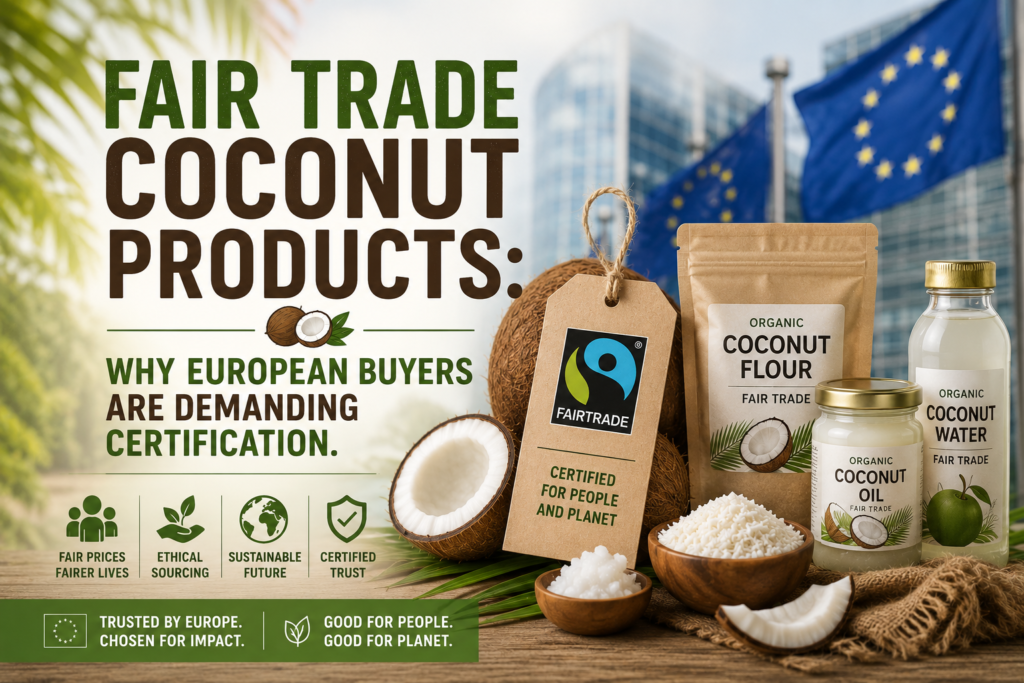
Fair Trade certification has moved from a niche ethical label to a mainstream sourcing requirement across European retail and food manufacturing. For coconut products specifically — sourced almost entirely from smallholder farming communities across South and Southeast Asia — the pressure on buyers to demonstrate ethical supply chains has never been higher.
This article explains why Fair Trade certification matters for coconut product sourcing, what it means in practice for EU importers and food manufacturers, and what to look for when selecting a certified Fair Trade coconut supplier from Sri Lanka.
Why Fair Trade Certification Is Now a Baseline Expectation in European Retail
A decade ago, Fair Trade was a differentiator — a label that premium and specialist retailers used to justify a higher shelf price. That dynamic has fundamentally changed. Across UK, German, Dutch, Scandinavian, and French grocery retail, Fair Trade coconut sourcing is increasingly a minimum requirement for supplier listing, not a premium add-on.
Several structural shifts have driven this change:
- EU Corporate Sustainability Due Diligence Directive (CSDDD): Now enacted into law, the CSDDD requires large EU companies to identify, prevent, and remedy adverse human rights and environmental impacts across their supply chains. For food importers and manufacturers, this creates a direct legal incentive to source from certified, audited suppliers rather than undocumented commodity channels.
- Retailer own-brand sustainability commitments: Major European grocery retailers — including Lidl, Aldi, Tesco, Albert Heijn, and Rewe — have published explicit commitments to sourcing certified sustainable ingredients for their own-label ranges by 2025–2030. Coconut products feature prominently in these commitments.
- Consumer demand and purchase behaviour: Research across EU markets consistently shows that European consumers — particularly in the 25–44 age bracket — actively seek ethical sourcing labels when purchasing food products. Fair Trade coconut products command measurable shelf offtake premiums in UK, German, and Scandinavian retail.
- Food manufacturer formulation requirements: Food manufacturers supplying certified B-Corp brands, organic product lines, or sustainability-positioned ranges are increasingly required to demonstrate Fair Trade sourcing for all primary ingredients — including coconut milk, cream, and desiccated coconut.
What Fair Trade Certification Means for Coconut Products
Fair Trade certification for coconut products is not a single standard — there are several internationally recognised schemes, each with different scope, requirements, and market acceptance. Understanding the differences matters when specifying supplier requirements.
Fairtrade International (FLO)
The most widely recognised Fair Trade standard in European retail. Fairtrade International certification for coconut products requires:
- A minimum price guarantee for coconut farmers — ensuring a floor price regardless of commodity market movements
- A Fairtrade Premium — an additional payment per unit (paid on top of the purchase price) that farming communities invest collectively in social, environmental, or economic development projects
- Democratic farmer organisation — coconut must be sourced from Fairtrade-certified farmer groups or cooperatives
- Annual third-party auditing of the full supply chain, from farm to export
- The right to use the FAIRTRADE Mark on product packaging — the most consumer-recognised ethical label in European grocery retail
Fair for Life (IMO)
An alternative Fair Trade certification operated by Control Union / IMO, widely accepted by European food manufacturers and retailers. Fair for Life certification is often preferred by manufacturers who require combined organic and fair trade audit scope from a single certification body — reducing administrative burden for suppliers and buyers alike.
Rainforest Alliance
While not strictly a Fair Trade certification, Rainforest Alliance is increasingly accepted by European retailers as an equivalent ethical sourcing credential for tropical agricultural products including coconuts. It combines social standards with environmental sustainability requirements and carries strong consumer recognition in several EU markets.
The Sri Lanka Advantage for Fair Trade Coconut Sourcing
Sri Lanka has a well-established Fair Trade coconut sector, and for European buyers, this matters significantly. Several structural features of the Sri Lanka coconut industry make it particularly well-suited to certified fair trade supply:
- Smallholder farming structure: The majority of Sri Lanka’s coconut cultivation is carried out by smallholder farmers — exactly the farming model that Fair Trade certification is designed to protect and support. This means the Fair Trade premium reaches individual farming families directly, not corporate plantation operations.
- Established farmer cooperative networks: Sri Lanka has a mature network of Fairtrade-certified farmer organisations, providing exporters with audited, certified raw material supply at scale.
- Integrated certification capability: Leading Sri Lanka coconut exporters hold concurrent EU Organic, Fairtrade, Halal, Kosher, and BRC certifications — allowing buyers to source certified on multiple dimensions from a single supplier rather than managing multiple supply relationships.
- Export infrastructure: Sri Lanka’s Colombo port is one of the busiest transshipment hubs in South Asia, with regular direct services to Rotterdam, Hamburg, Felixstowe, and Antwerp — supporting reliable lead times for EU importers.
Which Coconut Products Are Available Fair Trade Certified from Sri Lanka
The range of Fair Trade certified coconut products available from Sri Lanka exporters covers the full spectrum of coconut-derived ingredients used in European food manufacturing and retail:
| Product | Fair Trade Certified | Key EU Applications |
|---|---|---|
| Desiccated coconut (all grades) | Yes — Fairtrade International / Fair for Life | Bakery, confectionery, cereal, granola, retail packs |
| Coconut milk (canned & aseptic bulk) | Yes — Fairtrade International / Fair for Life | Food manufacturing, food service, retail own-label |
| Coconut cream (canned & aseptic bulk) | Yes — Fairtrade International / Fair for Life | Food manufacturing, food service, retail own-label |
| Virgin coconut oil | Yes — Fairtrade International / Fair for Life | Health food retail, cosmetics ingredient, food manufacturing |
| Coconut water (bulk aseptic & retail) | Yes — Fair for Life | Beverage manufacturing, retail private label |
| Coconut flour | Yes — Fair for Life | Gluten-free bakery, health food, food manufacturing |
| Coconut sugar | Yes — Fairtrade International / Fair for Life | Health food retail, natural sweetener ingredient |
How Fair Trade Certification Affects Pricing and MOQ
European buyers new to Fair Trade coconut sourcing often ask whether certified supply commands a significant price premium over commodity coconut products. The honest answer is nuanced.
Fair Trade certified coconut products from Sri Lanka do carry a premium over undocumented commodity supply — the Fairtrade Minimum Price and Fairtrade Premium are embedded costs within the supply chain. However, this premium is typically modest relative to the commercial and reputational value it unlocks for European buyers:
- Retailer listing eligibility — many UK and European retailers will not list own-label coconut products without Fair Trade certification, making certification a commercial necessity rather than an optional cost.
- The Fairtrade Mark on-pack drives measurable consumer purchase intent — particularly in UK, German, and Scandinavian retail where the mark has high consumer recognition.
- For food manufacturers supplying certified B-Corp or sustainability-positioned brands, Fair Trade sourcing documentation forms part of the brand’s supplier compliance requirement.
Minimum order quantities for Fair Trade certified coconut products from Sri Lanka are consistent with standard export quantities: FCL (Full Container Load) shipments of 18–20 metric tonnes for most product categories. LCL (Less than Container Load) consolidation is available for smaller importers, with lead times of 5–7 weeks ex-Colombo.
What Documentation to Request from a Fair Trade Coconut Supplier
When sourcing Fair Trade coconut products from Sri Lanka, European importers should request and verify the following documentation before placing a first order:
- Current Fair Trade certificate: Confirm it is issued by a recognised certification body (Fairtrade International / FLOCERT, Fair for Life / IMO, or Rainforest Alliance), covers the specific products being sourced, and is within its validity period.
- Transaction certificate (TC): For each shipment, request a transaction certificate confirming the specific goods being shipped are covered under the active Fair Trade certification scope.
- Fairtrade Premium records: Reputable certified suppliers can provide documentation of Fairtrade Premium payments made to farmer organisations — useful for buyer sustainability reporting.
- Combined EU Organic + Fair Trade certificate: If sourcing organic fair trade coconut products, confirm both certifications are current and cover the same product range. A single supplier holding both eliminates dual-sourcing complexity.
- Certificates of analysis: MRL residue testing, aflatoxin results (particularly for desiccated coconut and flour), and microbiological test results for the relevant production batches.
Fair Trade Coconut Products from Navik Mills
Navik Mills (Pvt) Ltd is a Sri Lanka-based organic coconut products manufacturer and exporter holding Fair Trade, EU Organic, Halal, Kosher, and BRC certification across our full product range. We supply food manufacturers, importers, and retail brands across 35+ countries, including active supply relationships with EU buyers across the UK, Germany, the Netherlands, France, and Scandinavia.
Our Fair Trade certified product range for EU buyers includes desiccated coconut in all grades, coconut milk and cream in bulk aseptic and retail-ready canned formats, virgin coconut oil, coconut water, coconut flour, and coconut sugar. Private label supply under your own brand is available across all certified product lines.
Sourcing Fair Trade coconut products for the European market? Contact our export team to request certificates, product specifications, and wholesale pricing.
Frequently Asked Questions
What is the difference between Fairtrade and Fair Trade?
“Fairtrade” (one word) refers specifically to the certification and mark operated by Fairtrade International (FLO) and its national member organisations. “Fair trade” (two words) is the broader ethical trade concept. When specifying certification requirements to a supplier, always clarify which certification body and standard you require.
Can Fair Trade certification be combined with EU Organic certification on the same product?
Yes — and this is the standard requirement from most EU retail buyers. Leading Sri Lanka coconut exporters hold concurrent Fairtrade International (or Fair for Life) and EU Organic certifications across their product ranges, allowing buyers to source organic fair trade coconut products from a single supplier under a single supply relationship.
Do Fair Trade certified coconut products from Sri Lanka qualify for GSP+ 0% EU import duty?
Yes. Sri Lanka’s GSP+ status with the EU applies based on the country of origin and product category — not on the Fair Trade certification status of the goods. Fair Trade certified coconut milk, cream, oil, water, and flour from Sri Lanka are eligible for 0% GSP+ import duty, provided the correct origin documentation (GSP Form A or REX Statement) accompanies the shipment.
How do I verify that a supplier’s Fair Trade certificate is genuine?
Request the certificate directly from the supplier and verify it through the issuing certification body. Fairtrade International certificates can be checked through the FLOCERT certificate database. Fair for Life certificates can be verified through the IMO/Control Union online registry. Always check that the specific product you are sourcing falls within the certified scope.
Is Fair Trade coconut available in private label formats?
Yes. Fair Trade certified private label coconut products are available from Sri Lanka manufacturers including Navik Mills. The Fair Trade or Fairtrade Mark can be applied to private label packaging subject to the certification body’s trademark licence requirements — your supplier can guide you through this process as part of the private label onboarding.
