
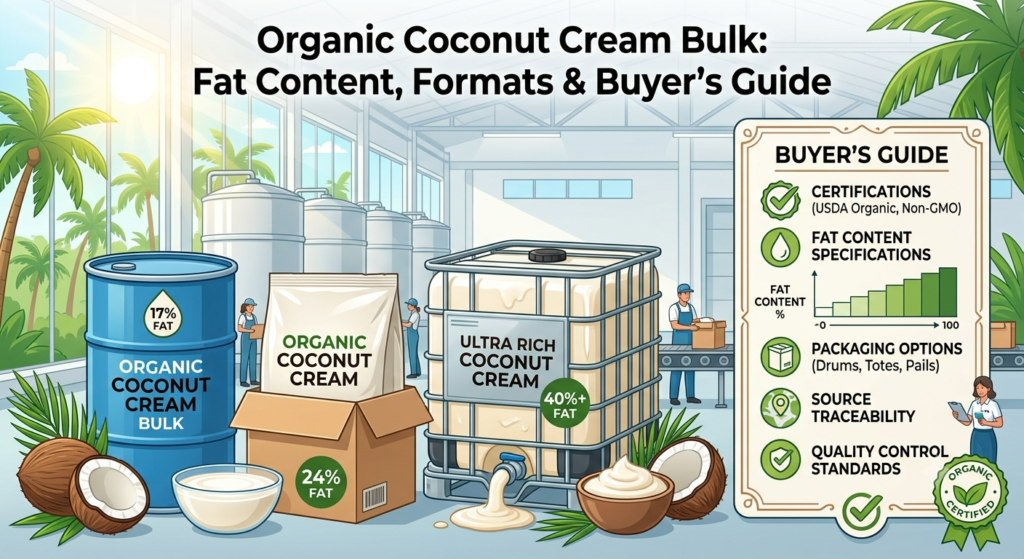
Organic coconut cream is one of the fastest-growing ingredients in the global food manufacturing sector. From dairy-free ice cream bases to premium cooking sauces, vegan whipped toppings to clean-label dessert formulations — the demand for high-fat, certified organic coconut cream is accelerating across every major market.
But for B2B buyers, sourcing bulk organic coconut cream is not as simple as requesting a price quote. Fat content, emulsifier choices, packaging format, and certification compliance all vary significantly between suppliers — and getting any of these wrong can compromise your end product.
This guide covers every specification and sourcing consideration that food manufacturers, private label brands, and ingredient distributors need to evaluate before committing to a bulk organic coconut cream supplier.
Coconut Cream vs Coconut Milk: The B2B Distinction
Before diving into specifications, it is important to clarify a distinction that is often misunderstood — even by experienced buyers:
| Parameter | Coconut Cream | Coconut Milk |
|---|---|---|
| Fat content | 20–30%+ | 5–18% |
| Extraction | First pressing of fresh coconut meat | Second pressing, or diluted first pressing |
| Consistency | Thick, rich, paste-like | Pourable liquid |
| Primary use | Ice cream, whipped toppings, rich sauces, confectionery | Beverages, soups, curries, dairy alternatives |
| Price point | Higher — more coconut required per litre | Lower |
The critical variable is fat content. In the B2B ingredient market, coconut cream starts at 20% fat and goes up to 30%+ for premium grades. Anything below 17–18% fat is classified as coconut milk, regardless of what some retail labels may claim.
Fat Content Grades: Choosing the Right Specification
Fat content is the single most important specification when ordering bulk coconut cream. It determines the product’s viscosity, mouthfeel, whipping capability, heat stability, and suitability for your specific application.
| Fat % | Grade Name | Best Applications | Key Characteristics |
|---|---|---|---|
| 20–22% | Standard Coconut Cream | Cooking sauces, soups, curries, food service | Good richness, pourable consistency, cost-effective |
| 24% | Premium Coconut Cream | Dairy alternatives, desserts, premium sauces, beverages | Industry standard for manufacturing — balances richness with workability |
| 30%+ | Extra-Thick / Heavy Coconut Cream | Whipped toppings, ice cream base, confectionery coatings, ganache | Maximum richness, holds whipped structure, luxurious mouthfeel |
Navik Mills produces coconut cream at 22% and 30% fat in both canned and aseptic bulk formats — covering the full range from food service standard to ultra-premium applications.
How Fat Content Affects Your End Product
- Ice cream and frozen desserts: Requires 24–30% fat for smooth texture and slow melt. Lower fat results in icy, grainy texture.
- Whipped toppings: Only 30%+ fat cream holds a stable whipped structure. 22% will not whip properly.
- Cooking sauces and curries: 20–22% fat provides adequate richness without excessive cost per unit.
- Coffee creamers: 22–24% fat emulsifies smoothly in hot beverages without separation.
- Confectionery: 30% fat delivers the dense, smooth mouthfeel required for ganache, truffles, and cream fillings.
Clean-Label vs Stabilised: The Additive Decision
One of the most critical formulation decisions in coconut cream sourcing is whether to use a clean-label (additive-free) or stabilised product.
Clean-Label Coconut Cream
- Ingredients: Organic coconut extract, water — nothing else
- Advantages: Meets “clean label” retailer requirements, simplest ingredient declaration, appeals to health-conscious consumers
- Trade-off: Natural fat separation will occur — the cream layer rises to the top. This is normal and expected, but requires shaking or mixing before use
- Best for: Organic retail brands, health food channels, premium positioning
Stabilised Coconut Cream
- Common stabilisers: Guar gum (E412), xanthan gum (E415), carboxymethyl cellulose (E466)
- Advantages: Homogeneous consistency throughout shelf life, no separation, easier to use in automated production lines
- Trade-off: Cannot claim “clean label”, some retail buyers reject products with E-numbers
- Best for: Food service, industrial food manufacturing, products where consistency is critical
Navik Mills offers both clean-label and stabilised organic coconut cream variants, allowing buyers to choose the formulation that matches their market positioning.
Bulk Packaging Formats
The right packaging format depends on your production scale, storage infrastructure, and whether you are repacking for retail or using coconut cream as an industrial ingredient.
| Format | Volume | Storage | Best For | Shelf Life |
|---|---|---|---|---|
| Aseptic Bag-in-Box | 20 litres | Ambient | Food service, small-batch production, sample orders | 12–18 months |
| Aseptic Bag-in-Drum | 200 litres | Ambient | Mid-scale manufacturing, dairy alternative production | 12–18 months |
| Aseptic IBC Tote | 1,000 litres | Ambient | High-volume continuous production lines | 12–18 months |
| Canned (retail-ready) | 160mL / 200mL / 400mL | Ambient | Retail, private label, e-commerce | 24–36 months |
Why aseptic matters for bulk: Aseptic processing (UHT sterilisation in a sterile environment) eliminates the need for refrigeration during shipping and storage. This dramatically reduces logistics costs compared to chilled or frozen supply chains — a critical factor for importers shipping from Sri Lanka to Europe, North America, or the Middle East.
Technical Specifications: Your Pre-Order Checklist
| Parameter | 22% Fat Cream | 30% Fat Cream | Why It Matters |
|---|---|---|---|
| Fat content | 21–23% | 29–31% | Must match your formulation requirements — verify via COA |
| pH | 5.8–6.2 | 5.8–6.2 | Affects microbiological stability and taste |
| Brix | 8–12 | 12–18 | Higher Brix correlates with richer coconut flavour |
| Total solids | 25–30% | 35–42% | Indicates concentration — higher = more coconut per unit |
| Viscosity | Medium | Thick / paste-like | Determines pourability and processing behaviour |
| Colour | White to off-white | Bright white | Grey or yellow tones indicate inferior raw material |
| Total plate count | <10 CFU/mL | <10 CFU/mL | Commercial sterility essential for ambient shelf life |
| Yeast & mould | <1 CFU/mL | <1 CFU/mL | Must be undetectable in aseptic formats |
Applications: How Manufacturers Use Bulk Coconut Cream
| Industry | Application | Recommended Fat % |
|---|---|---|
| Dairy alternatives | Vegan yoghurt, cream cheese, sour cream substitutes | 24–30% |
| Frozen desserts | Coconut ice cream, sorbets, frozen bars | 24–30% |
| Bakery & patisserie | Cream fillings, ganache, mousse, frosting | 30% |
| Ready meals | Thai curries, Indian sauces, coconut-based soups | 20–22% |
| Beverages | Coconut-based coffee creamers, RTD smoothies | 22–24% |
| Confectionery | Chocolate truffles, coconut pralines, cream centres | 30% |
| Food service | Restaurant cooking cream, hotel kitchen supply | 20–22% |
| Infant nutrition | Plant-based infant formula fat source | 24–30% (pharmaceutical grade) |
Certifications Required for Organic Coconut Cream
To sell organic coconut cream in premium international markets, your supplier must hold the following certifications:
- USDA NOP Organic — mandatory for “organic” claims in the United States and Canada
- EU Organic (EC 2018/848) — required for organic labelling in all EU member states
- BRCGS — food safety certification required by most UK and European retail chains
- FSSC 22000 / HACCP — food safety management system certification
- Fair Trade — increasingly demanded by European retailers for coconut products
- Halal & Kosher — essential for Middle Eastern, South-East Asian, and specific Western retail channels
- Vegan certified — confirms suitability for plant-based product positioning
Navik Mills holds the complete certification stack — enabling B2B buyers to access every major international market from a single, vertically integrated supplier.
Why Source Organic Coconut Cream from Sri Lanka?
- Superior coconut quality — the Coconut Triangle’s laterite soils produce coconuts with naturally high fat content, creating richer cream from fewer raw materials
- Smallholder organic supply — 80%+ of coconuts come from farms that are naturally organic by practice, ensuring genuinely clean raw material
- Aseptic processing capability — Sri Lankan manufacturers like Navik Mills have invested in modern UHT and aseptic filling technology for bulk supply
- Private label expertise — full white-label programmes including custom fat %, stabiliser choices, and retail packaging design
- Competitive pricing — vertically integrated supply chains (farm → factory → export) eliminate intermediary margins
- Ethical sourcing — Fair Trade certified, no monkey labour, active CSR programmes
Request Organic Coconut Cream Samples →
Frequently Asked Questions
What is the difference between coconut cream and coconut milk?
The primary difference is fat content. Coconut cream contains 20–30%+ fat and is extracted from the first pressing of fresh coconut meat, resulting in a thick, rich consistency. Coconut milk contains 5–18% fat and is either from a second pressing or a diluted first pressing, giving it a pourable liquid consistency. For B2B applications, always specify the exact fat percentage rather than relying on product names.
What fat percentage should I choose for my product?
It depends on your application. Use 20–22% fat for cooking sauces, curries, and food service. Use 24% for dairy alternatives, coffee creamers, and desserts. Use 30%+ for whipped toppings, ice cream bases, confectionery, and any application requiring a thick, luxurious texture. Only 30% fat cream holds a stable whipped structure.
Should I use clean-label or stabilised coconut cream?
Clean-label (no additives) is ideal for organic retail brands and health-conscious positioning, but natural fat separation will occur. Stabilised cream (with guar gum or similar) maintains homogeneous consistency throughout shelf life and is easier for automated production lines. Choose based on your market positioning and production requirements.
What is the shelf life of aseptic bulk coconut cream?
Aseptic coconut cream stored at ambient temperature typically has a shelf life of 12–18 months from production date. Canned coconut cream in retail formats can last 24–36 months. Always request a shelf life study from your supplier and verify storage conditions specified on the Certificate of Analysis.
Can I get private label organic coconut cream from Sri Lanka?
Yes. Navik Mills offers full private label programmes for organic coconut cream, including custom fat percentages (22%, 24%, 30%), choice of clean-label or stabilised formulation, custom packaging (cans, aseptic bags, retail pouches), and label design support. Contact them directly with your brand requirements and target market for a detailed quotation.
