
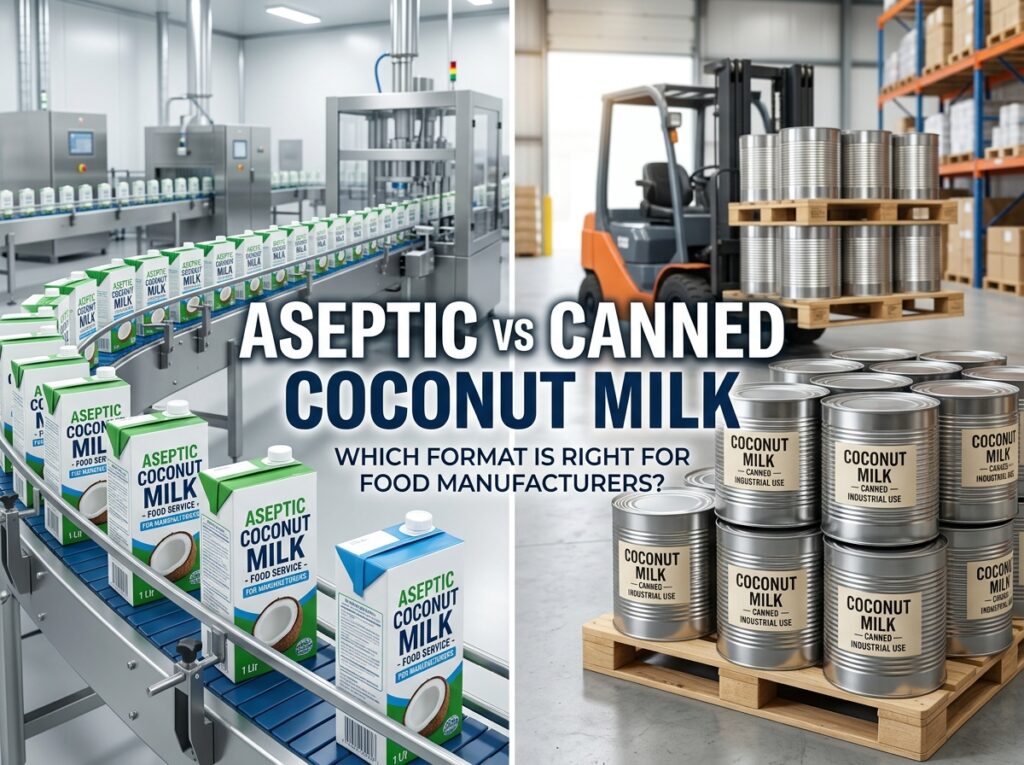
For food manufacturers sourcing coconut milk and cream as a production ingredient, format selection is one of the most consequential — and frequently underestimated — procurement decisions. The choice between bulk aseptic and canned coconut milk affects unit cost, storage requirements, production line integration, shelf life management, and ultimately your finished product’s cost of goods.
This guide compares aseptic and canned coconut milk formats across every dimension that matters for food manufacturing — helping procurement teams, product developers, and operations managers make the right format decision for their specific production environment.
Understanding the Two Formats: How They Are Produced
Before comparing formats, it is worth understanding what differentiates aseptic and canned coconut milk at the production level — because the manufacturing process directly determines the functional differences buyers experience downstream.
Bulk Aseptic Coconut Milk
Aseptic coconut milk is produced using Ultra High Temperature (UHT) processing — the product is heated to approximately 140°C for 2–4 seconds, then immediately cooled and filled into pre-sterilised packaging under sterile conditions. The result is a commercially sterile product that requires no preservatives and no refrigeration, packaged in bag-in-box formats (typically 10–20 litres) or large intermediate bulk containers (IBCs) of 200–1,000 litres.
The aseptic process preserves the natural flavour profile and nutritional composition of coconut milk more effectively than traditional thermal processing — making it the preferred format for food manufacturers where ingredient quality and consistency are priorities.
Canned Coconut Milk
Canned coconut milk is produced by filling raw or partially processed coconut milk into sealed cans (typically 160ml, 400ml, or 800ml), which are then subjected to retort sterilisation — a high-heat, high-pressure process that achieves commercial sterility within the sealed container. The retort process is effective but applies more intense thermal treatment than aseptic processing, which can affect flavour and fat separation characteristics.
Canned formats are retail-ready by design — they are the finished consumer unit, not a bulk ingredient format. When food manufacturers use canned coconut milk in production, they are typically working around a supply chain designed for retail, not manufacturing efficiency.
Head-to-Head Comparison: Aseptic vs Canned for Food Manufacturing
| Factor | Bulk Aseptic | Canned (Retail Format) |
|---|---|---|
| Unit cost | Significantly lower per litre — no individual can, retort processing, or retail packaging cost | Higher per litre — retail packaging and retort processing embedded in unit price |
| Shelf life | 12–18 months at ambient temperature | 24–36 months at ambient temperature |
| Production line integration | Direct pump-to-line from IBC or bag-in-box — no manual opening, no waste, no can disposal | Manual or semi-automated can opening required — labour cost, hygiene risk, metal waste stream |
| Minimum order quantity | FCL (Full Container Load) — typically 18–20 MT | FCL — typically 18–20 MT (but priced as retail units) |
| Fat content consistency | Homogenised — consistent fat content batch to batch | Fat separation in can is common — inconsistency between units affects formulation |
| Flavour profile | Cleaner, fresher coconut flavour — lighter thermal treatment | Slightly cooked or caramelised note from retort — more pronounced in some applications |
| Storage footprint | Compact IBC or bag-in-box — high volume per pallet | Bulkier per litre due to can dimensions and packing configuration |
| Packaging waste | Minimal — single IBC or bag-in-box per large volume | High — individual steel cans per litre of product |
| Private label / own brand | Supplied in bulk — manufacturer fills into own packaging | Available from supplier in branded or unbranded cans |
| Best for | Food manufacturers, beverage producers, food service chains | Retail brands, food service (small volume), recipe kit companies |
When to Choose Bulk Aseptic Coconut Milk
Bulk aseptic is the correct format choice for the majority of food manufacturing applications. If any of the following apply to your operation, aseptic supply will deliver meaningful cost and operational advantages over canned:
You Are Formulating a Product at Scale
When coconut milk or cream is a primary ingredient in a product manufactured at volume — sauces, soups, curries, ready meals, beverages, confectionery, ice cream, or dairy-free alternatives — the unit cost difference between aseptic and canned becomes substantial at FCL quantities. A manufacturer processing 5,000 litres of coconut milk per week will see a significant cost of goods improvement by switching from canned to bulk aseptic, with no compromise on ingredient specification.
Production Line Efficiency Is a Priority
Aseptic IBCs connect directly to production line inlets via hygienic fittings — no manual handling, no can-opening stations, no waste management for empty steel units. For high-throughput production environments, this translates directly to reduced labour cost, improved hygiene control, and faster line throughput. Bag-in-box formats (10–20L) offer the same direct-feed capability at smaller batch sizes.
You Need Consistent Ingredient Specification
Aseptic coconut milk is homogenised prior to filling, ensuring consistent fat content, Brix, and viscosity batch to batch. Canned coconut milk — where fat naturally separates within the sealed can during storage — introduces ingredient variability that can affect finished product texture, taste, and nutritional labelling consistency. For food manufacturers with tight product specifications, aseptic supply is the more reliable choice.
You Are Targeting Organic or Fair Trade Certification
Bulk aseptic coconut milk is available with full EU Organic, Fairtrade, Halal, Kosher, and BRC certification from Sri Lanka manufacturers including Navik Mills. For food manufacturers producing certified product ranges, aseptic bulk supply is the most practical format for certified ingredient integration at volume.
When Canned Coconut Milk Makes Sense for a Food Business
Despite the cost and operational advantages of aseptic for high-volume manufacturing, canned formats remain the right choice in specific commercial contexts:
- Retail-ready private label ranges: If your business is building a branded or own-label coconut milk product for retail, canned is the finished consumer unit. Aseptic bulk would require secondary filling infrastructure that most brand owners do not operate in-house.
- Food service with small batch production: Restaurant groups, catering operations, and meal kit companies using coconut milk in kitchen preparation — rather than industrial production — will find canned formats more practical given the absence of bulk handling equipment.
- Extended shelf life is the priority: Where 36-month shelf life is a specific requirement — for example, emergency food supply, long-cycle retail programmes, or export to markets with slow inventory turnover — canned formats offer a longer ambient shelf life than most aseptic products.
- Low volume or pilot production: New product development, recipe trials, or small-batch production runs where total ingredient volume does not justify FCL aseptic procurement. Most aseptic suppliers set FCL minimum order quantities.
Fat Content and Specification: What Food Manufacturers Need to Know
Coconut milk and cream are available in multiple fat content specifications, and format choice intersects with fat specification in ways that matter for product formulation.
| Product | Typical Fat Content | Primary Manufacturing Application | Available Aseptic |
|---|---|---|---|
| Coconut cream | 20–24% fat | Confectionery, ice cream, premium sauces, dairy-free cream alternatives | Yes |
| Coconut milk (full fat) | 17–19% fat | Soups, curries, ready meals, beverages, bakery | Yes |
| Coconut milk (light) | 5–7% fat | Lower-calorie product ranges, beverage bases, health food | Yes |
| Coconut milk powder | 65–70% fat (reconstitutes) | Dry blends, instant products, bakery mixes, long shelf life formulations | N/A (dry format) |
When specifying coconut milk or cream for a manufacturing application, always request a full technical data sheet from your supplier showing fat content, Brix, pH, viscosity, microbiological parameters, and shelf life under ambient storage conditions. Navik Mills provides full technical specifications and certificates of analysis for every product and batch.
Organic and Fair Trade Certification Across Formats
For food manufacturers operating certified product ranges — organic, Fair Trade, B-Corp, or sustainability-positioned — the certification status of the coconut milk format matters as much as the format itself.
Both aseptic and canned coconut milk are available with full certification stacks from leading Sri Lanka manufacturers. However, there are practical differences worth noting:
- Bulk aseptic is the most common format for certified ingredient supply to food manufacturers. EU Organic, Fairtrade International, Fair for Life, Halal, and Kosher certifications are all available on aseptic bulk product from Navik Mills.
- Canned private label with certification is also available — the FAIRTRADE Mark and EU Organic logo can be applied to private label canned formats subject to the relevant certification body’s trademark licence requirements.
- Always request transaction certificates for each shipment — these confirm the specific batch shipped is covered under the active certification scope, not just that the supplier holds a general certification.
Logistics and Lead Times: What to Plan For
Whether sourcing aseptic or canned coconut milk from Sri Lanka, European food manufacturers should build the following logistics parameters into their procurement planning:
- Production lead time: 3–4 weeks from order confirmation for standard specification product. Custom fat content, label specification, or certified batches may require additional lead time — confirm with your supplier at time of order.
- Sea freight transit: 18–24 days Colombo to major EU ports (Rotterdam, Hamburg, Felixstowe, Antwerp). Total lead time from order to EU warehouse is typically 6–10 weeks.
- FCL quantities: A standard 20-foot container holds approximately 18–20 metric tonnes of coconut milk or cream in either aseptic or canned format. LCL (Less than Container Load) consolidation is available for smaller volumes at extended lead times.
- GSP+ duty benefit: Both aseptic and canned coconut milk from Sri Lanka qualify for 0% EU import duty under Sri Lanka’s GSP+ status — a direct cost advantage over Thai or Philippine supply. Ensure your supplier provides the correct GSP Form A or REX Statement of Origin with each shipment.
Sourcing Aseptic and Canned Coconut Milk from Navik Mills
Navik Mills (Pvt) Ltd manufactures and exports both bulk aseptic and retail-ready canned coconut milk and cream from Sri Lanka, supplying food manufacturers, importers, and retail brands across 35+ countries. Our supply offering for food manufacturing buyers includes:
- Bulk aseptic coconut milk and cream in 10L bag-in-box, 200L and 1,000L IBCs
- Retail-ready canned coconut milk and cream in 160ml, 400ml, and 800ml BPA-free cans
- Full fat, light, and custom fat content specifications available to order
- EU Organic, Fairtrade, Halal, Kosher, and BRC certification across both formats
- Full technical data sheets, certificates of analysis, and batch traceability documentation supplied with every order
- Private label capability — own brand packaging design and production for both aseptic and canned formats
Ready to discuss format options for your manufacturing requirements? Contact our export team to request technical specifications, sample pricing, and certificates of analysis.
Frequently Asked Questions
What is the shelf life of bulk aseptic coconut milk compared to canned?
Bulk aseptic coconut milk from Sri Lanka suppliers typically carries a shelf life of 12–18 months at ambient temperature from the date of production. Canned coconut milk generally has a longer ambient shelf life of 24–36 months due to the sealed metal container. For most food manufacturing applications, the 12–18 month aseptic shelf life is more than sufficient given standard inventory turnover cycles.
Can I get organic certified bulk aseptic coconut milk from Sri Lanka?
Yes. EU Organic certified bulk aseptic coconut milk is available from Sri Lanka manufacturers including Navik Mills. Each shipment is accompanied by a Certificate of Inspection (COI) issued via TRACES NT confirming the organic status of the batch. Fair Trade certification can be combined with EU Organic on the same aseptic product.
What is the minimum order quantity for bulk aseptic coconut milk?
The standard minimum order for bulk aseptic coconut milk is one Full Container Load (FCL), equating to approximately 18–20 metric tonnes depending on the specific format (IBC or bag-in-box) and product specification. Smaller quantities can be arranged via LCL consolidation, though this adds cost and extends lead times to 5–7 weeks ex-Colombo.
How does fat separation in canned coconut milk affect food manufacturing?
Fat naturally separates and solidifies at the top of a sealed can during storage, particularly in cooler ambient conditions. For food manufacturers, this means individual cans may have inconsistent fat distribution — affecting ingredient measurement accuracy, formulation consistency, and production hygiene when opening large numbers of cans on a production line. Bulk aseptic coconut milk is homogenised prior to filling, eliminating this variability.
Does coconut milk from Sri Lanka qualify for 0% EU import duty?
Yes. Both aseptic and canned coconut milk from Sri Lanka qualify for 0% EU import duty under Sri Lanka’s GSP+ status with the EU. The correct origin documentation — a GSP Form A or REX Statement of Origin — must accompany each shipment. Navik Mills provides full GSP+ documentation as standard with all EU export orders.
