
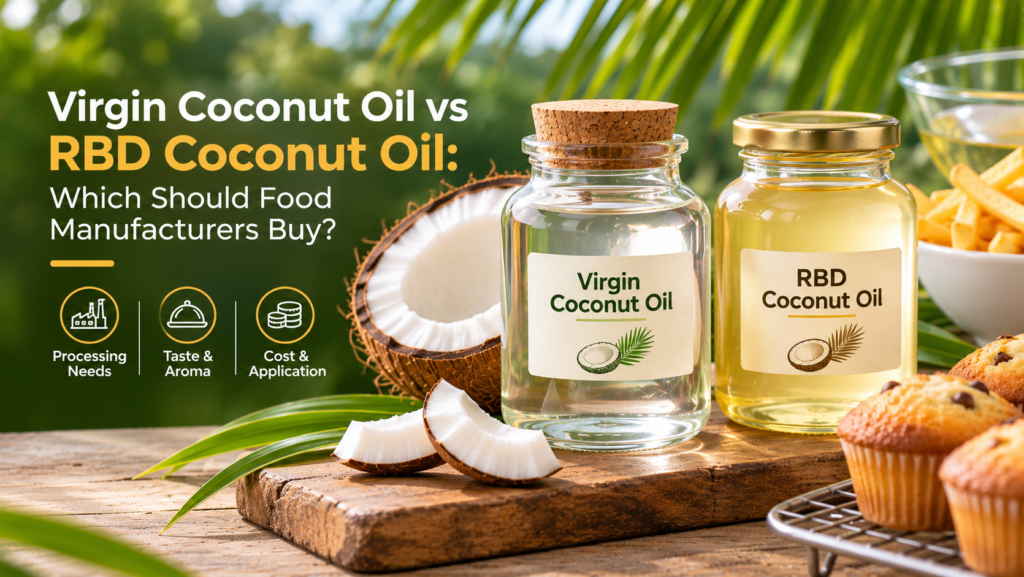
Coconut oil is one of the most widely used fats in food manufacturing. But when you ask a supplier for a quote, the first question you will hear is: virgin or refined? The two oils come from the same fruit, yet they are made differently, taste different, cost different amounts and suit different products.
This guide explains the difference in simple terms, and helps you choose the right coconut oil for your product, your label and your budget.
The Short Answer
- Choose virgin coconut oil (VCO) when you want a natural coconut taste and aroma, a “virgin” or “unrefined” claim on your label, or a premium, minimally processed product.
- Choose refined (RBD) coconut oil when you want a neutral taste and smell, high-heat cooking performance and the lowest cost per kilo.
Many manufacturers use both: VCO in their premium or “hero” products, and RBD where the oil works in the background.
How Each Oil Is Made
Virgin coconut oil (VCO)
VCO is made from fresh coconut kernel. The oil is separated by mechanical or natural means — pressing, centrifuging or natural separation — without high heat and without chemical refining. Because it is not refined, it keeps the fresh, mild coconut taste and aroma of the fruit.
For a detailed look at how different VCO methods affect the final oil, see our guide: cold-pressed vs centrifuge virgin coconut oil.
RBD coconut oil
RBD stands for Refined, Bleached and Deodorised. It is usually made from copra — coconut kernel that has been dried, often in the sun or over heat. Oil pressed from copra is crude and needs cleaning before it can be eaten, so it goes through three steps:
- Refining — removes free fatty acids and impurities.
- Bleaching — removes colour, usually using special clays.
- Deodorising — uses high heat and steam to remove smell and taste.
The result is a clear, colourless oil with almost no coconut flavour or aroma.
Side-by-Side Comparison
| Feature | Virgin Coconut Oil (VCO) | RBD Coconut Oil |
|---|---|---|
| Raw material | Fresh coconut kernel | Copra (dried kernel) |
| Processing | Mechanical or natural, no chemical refining | Refined, bleached and deodorised |
| Taste and smell | Mild, fresh coconut | Neutral — almost none |
| Colour (liquid) | Water-clear | Clear to pale yellow |
| Heat use | Good for baking and medium-heat cooking | Better for frying and high-heat processing |
| Cost | Higher | Lower |
| Label claims | “Virgin”, “unrefined”, often organic | “Coconut oil” or “refined coconut oil” |
| Fatty acid profile | Very similar. Both are around 90% saturated fat, and lauric acid is the main fatty acid in both. | |
One point that surprises many buyers: the basic fat make-up of VCO and RBD is almost the same. The real differences are in flavour, aroma, the minor natural compounds that survive in VCO, the processing story and the price.
Which Oil for Which Product?
| Product Type | Usually Best Choice | Why |
|---|---|---|
| Retail jars of coconut oil | VCO | Shoppers expect coconut aroma and a “virgin” claim. |
| Coconut-flavoured bakery, granola, bars | VCO | The coconut taste is part of the product. |
| Organic and “clean label” brands | VCO | Minimal processing supports the brand story. |
| Frying, snack foods, roasting | RBD | Handles high heat and has no coconut taste. |
| Chocolate, confectionery coatings, fillings | RBD (often) | Neutral taste lets cocoa and other flavours lead. |
| Plant-based cheese and dairy alternatives | Either | RBD for neutral flavour; VCO where a coconut note is welcome. |
| Non-dairy creamers and processed foods | RBD | Lowest cost and no flavour impact. |
What Is “White Coconut Oil” from Sri Lanka?
Buyers sourcing from Sri Lanka often see the term “white coconut oil”. It usually describes a clear, colourless coconut oil that is clean in taste. The trouble is that the term is used loosely — it can describe virgin coconut oil, or a refined oil, depending on the seller.
Simple rule: if a supplier offers “white coconut oil”, ask exactly how it is made. Is it made from fresh kernel or copra? Is it refined? Does it meet a virgin coconut oil specification? The answer decides what you can legally and honestly put on your label.
Specifications to Check
Whichever oil you choose, ask for a full product specification and a certificate of analysis (COA) for every batch.
| Parameter | What It Tells You |
|---|---|
| Free fatty acids (FFA) | Freshness and quality. High FFA can mean poor raw material or old oil. Good VCO and RBD both have low FFA. |
| Moisture | Water speeds up spoilage. Should be very low, especially for VCO. |
| Peroxide value | An early sign of oxidation (rancidity). Lower is better. |
| Lauric acid content | Confirms the oil is genuine coconut oil and not blended with other oils. |
| Colour, odour and taste | VCO should smell of fresh coconut — not smoky, sour or burnt. RBD should be neutral. |
| Process contaminants (RBD) | High-heat refining can form contaminants such as 3-MCPD and glycidyl esters. The EU and other markets set maximum levels — ask your supplier for test results. |
For VCO, many buyers also check against recognised industry standards, such as the Codex standard for named vegetable oils or the International Coconut Community’s virgin coconut oil standard. Ask your supplier which standard their oil is tested against.
Packaging and Shelf Life
Bulk coconut oil — virgin or refined — is commonly supplied in food-grade drums, IBC totes or flexitanks for full container loads. Jars, bottles and pouches are available for retail and private label.
Coconut oil is one of the most stable cooking oils because it is mostly saturated fat. Stored sealed, away from heat and light, it typically keeps for around two years. Always follow the shelf life on the supplier’s specification. Note that coconut oil turns solid below about 24°C, so it may arrive solid in cooler markets — this is normal and does not affect quality.
Coconut Oil from Navik Mills
Navik Mills (Pvt) Ltd is a Sri Lanka-based coconut products manufacturer and exporter supplying food manufacturers, importers and retail brands across 35+ countries.
- Virgin coconut oil in bulk and retail-ready formats, with private label available
- Ask us about refined coconut oil options for neutral-flavour applications
- Organic, Fair Trade, Halal, Kosher and BRC certification
- Full product specifications and a certificate of analysis with every batch
- Samples available for formulation trials
Not sure which coconut oil fits your product? Contact our export team for specifications, samples and wholesale pricing. You can also read our guide on how to choose a certified coconut products supplier.
Frequently Asked Questions
What is the difference between virgin and refined coconut oil?
Virgin coconut oil is made from fresh coconut kernel without chemical refining, so it keeps a mild coconut taste and aroma. Refined (RBD) coconut oil is usually made from dried copra and is refined, bleached and deodorised, giving a neutral taste and smell.
What does RBD coconut oil mean?
RBD stands for Refined, Bleached and Deodorised. It describes coconut oil that has been cleaned of impurities, colour and odour, usually after being pressed from dried coconut kernel (copra).
Which coconut oil is better for frying?
Refined (RBD) coconut oil is usually better for frying and high-heat processing because it handles higher temperatures and adds no coconut flavour. Virgin coconut oil suits baking and medium-heat cooking where a coconut taste is welcome.
What is white coconut oil from Sri Lanka?
“White coconut oil” usually describes a clear, colourless, clean-tasting coconut oil. The term is used loosely and can refer to virgin or refined oil, so buyers should always ask the supplier how the oil is made.
How long does bulk coconut oil last?
Coconut oil is very stable because it is mostly saturated fat. Stored sealed and away from heat and light, it typically lasts around two years. Always follow the shelf life on the supplier’s specification.
