
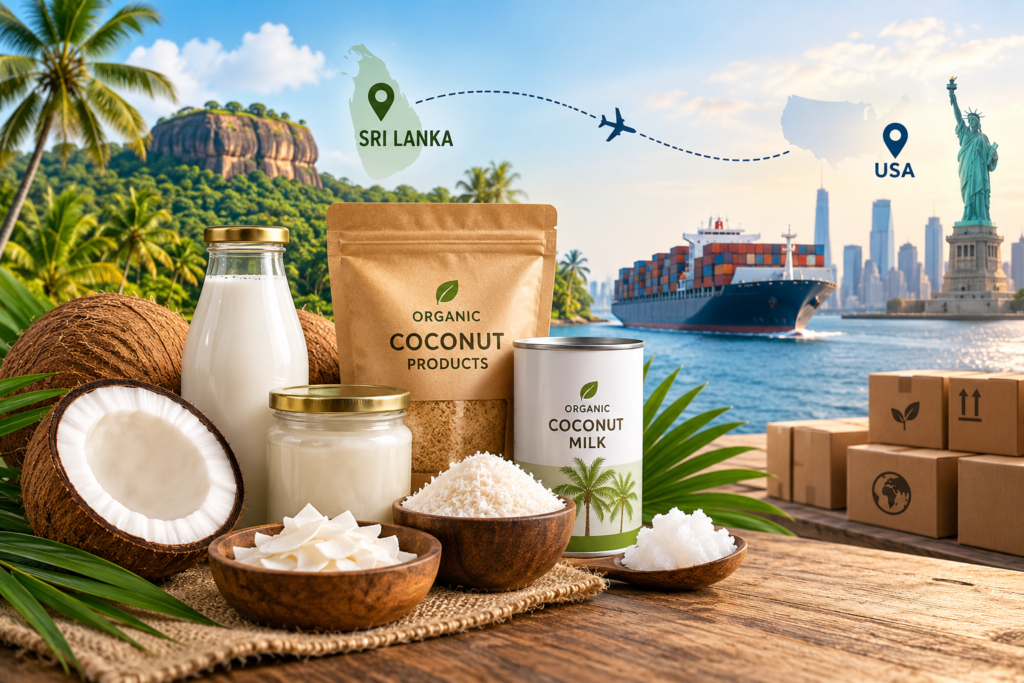
The United States is the single largest market for Sri Lankan coconut products. American food manufacturers, distributors and retail brands buy Sri Lankan coconut milk, cream, desiccated coconut, virgin coconut oil and coconut water for their quality, flavour and certification strength.
But importing organic food into the US is more regulated than ever. New USDA organic import rules, FDA food safety requirements and a fast-changing tariff picture all affect cost and lead time. This guide explains, step by step, what a US importer needs to know before sourcing organic coconut products from Sri Lanka.
Why US Buyers Source Coconut Products from Sri Lanka
- Flavour and quality: Sri Lankan coconuts are known for a rich, clean taste and naturally creamy texture — a clear advantage in coconut milk, cream and desiccated coconut.
- Strong certification base: Leading Sri Lankan exporters hold USDA Organic, Fair Trade, Halal, Kosher and BRC certification together, so one supplier can meet many buyer requirements.
- Vertical integration: Many Sri Lankan manufacturers control the chain from plantation to finished pack, giving US buyers better traceability.
- Wide product range: One supplier can provide coconut milk, cream, water, desiccated coconut, oil, flour, sugar and aminos — making consolidated shipments easier.
- Private label experience: Sri Lankan factories have long supplied US retail brands under their own labels.
USDA Organic Requirements for Imported Coconut Products
To sell a coconut product as “organic” in the US, it must be certified to the USDA National Organic Program (NOP) standard. The rules for imports became much stricter under the Strengthening Organic Enforcement (SOE) rule, which has been fully in force since March 2024.
What the SOE rule means for importers
- Every organic shipment needs an NOP Import Certificate. This is a transaction certificate that shows the quantity, product and origin of the organic goods.
- The exporter requests it. The Sri Lankan exporter applies to its USDA-accredited certifier, which issues the certificate in the USDA Organic Integrity Database — ideally before the goods leave Sri Lanka.
- It is entered at US customs. Your customs broker enters the unique NOP Import Certificate number in the CBP ACE system when the goods arrive.
- Importers must be certified too. Under SOE, most businesses that import, trade or handle organic products must hold their own organic certification.
- One certificate per relationship. A separate certificate is needed for each exporter–importer relationship, product and HTS code.
Buyer tip: Before ordering, confirm your supplier’s certifier can issue NOP Import Certificates quickly and check the supplier’s listing in the USDA Organic Integrity Database. Shipments without a valid certificate cannot be sold as organic.
FDA Requirements for Importing Coconut Products
All food entering the US is regulated by the U.S. Food and Drug Administration (FDA). For coconut products from Sri Lanka, the key requirements are:
- Food Facility Registration: The Sri Lankan manufacturing facility must be registered with the FDA. Registrations must be renewed every two years, between October and December of even-numbered years.
- Prior Notice: The FDA must be notified before each food shipment arrives in the US. Your customs broker usually files this.
- Foreign Supplier Verification Program (FSVP): Under the Food Safety Modernization Act (FSMA), the US importer must verify that the foreign supplier produces food safely. This usually means collecting the supplier’s food safety plan, audit reports and test results.
- Low-acid canned food rules: Canned and aseptic coconut milk and cream may fall under FDA rules for low-acid and acidified canned foods. The manufacturer may need to register its process (scheduled process filing) with the FDA. Ask your supplier to confirm this is in place.
US Labelling Rules for Coconut Products
Retail-ready products must meet FDA labelling rules. If you are importing for private label, your supplier should prepare packaging to these rules:
- Nutrition Facts panel in the current FDA format
- Ingredient list in descending order by weight
- Net quantity in both US customary and metric units (e.g. 13.5 fl oz / 400 ml)
- Country of origin — “Product of Sri Lanka”
- Name and address of the manufacturer, packer or distributor
- USDA Organic seal (optional, but valuable for retail) — only for products that meet the organic standard
Good news: coconut is no longer a tree nut allergen
In January 2025, the FDA updated its allergen guidance and removed coconut from the list of tree nuts that must be declared as major food allergens. This means coconut products no longer need a “Contains: tree nuts” statement. Coconut must still appear by name in the ingredient list. This change makes coconut ingredients easier to use for US food manufacturers and brands.
US Tariffs on Coconut Products from Sri Lanka
US tariffs on Sri Lankan goods have changed several times since 2025. Here is the position as of October 2026:
- Normal duty (MFN): Each product pays the standard US duty for its HTS code. Some coconut lines are duty-free; others carry a small duty. Sri Lanka no longer receives GSP duty-free treatment, because the US GSP programme expired at the end of 2020.
- 10% additional duty: Since July 2026, most Sri Lankan goods pay an extra 10% Section 301 duty on top of the normal duty.
- Exemptions that help coconut buyers: Coconuts (including desiccated coconut) and coconut oil are on the exemption list, so they do not pay the extra 10%.
- Earlier tariffs ended: The 20% “reciprocal” tariff applied from August 2025 stopped being collected in February 2026 after a US Supreme Court ruling.
| Product | Typical HTS Heading | Extra 10% Duty (Oct 2026) |
|---|---|---|
| Desiccated coconut | 0801.11 | Exempt |
| Virgin coconut oil | 1513.11 / 1513.19 | Exempt |
| Coconut milk and cream | 2106.90 (varies) | Applies |
| Coconut water | 2009.89 / 2202 (varies) | Check with your broker |
| Coconut flour, sugar, aminos | Varies by product | Check with your broker |
Note: Tariffs change often and depend on the exact 10-digit HTS code. This table is a general guide only, not legal or customs advice. Always confirm current duties with a licensed US customs broker before you order.
US importers also pay standard customs fees on each entry, such as the Merchandise Processing Fee and, for sea freight, the Harbor Maintenance Fee.
Shipping Routes and Lead Times: Colombo to the USA
Most coconut products travel from Colombo by sea in 20ft or 40ft containers. Typical transit times are:
| Route | Approx. Sea Transit Time |
|---|---|
| Colombo → Los Angeles / Long Beach (West Coast) | 25–35 days |
| Colombo → New York / New Jersey (East Coast) | 30–40 days |
| Colombo → Savannah / Charleston (Southeast) | 30–40 days |
| Colombo → Houston (Gulf Coast) | 35–45 days |
Transit times are indicative and vary by shipping line, transhipment port and season.
Allow around 8–12 weeks in total from order confirmation to arrival, including production, export paperwork and sea freight. For your first order, add extra time for samples, label approval and organic paperwork.
Remember that your broker must also file an Importer Security Filing (ISF 10+2) at least 24 hours before the container is loaded onto the ship bound for the US.
Documents to Request from Your Sri Lankan Supplier
- USDA Organic certificate — current and covering the exact products you are buying
- NOP Import Certificate — for every organic shipment
- FDA Food Facility Registration number
- Food safety certificate — e.g. BRC Global Standard for Food Safety
- Certificate of analysis (COA) for each batch — microbiology, fat content and other key specs
- Commercial invoice, packing list, bill of lading and certificate of origin
- Halal, Kosher or Fair Trade certificates — if your customers need them
Organic Coconut Products for the US Market from Navik Mills
Navik Mills (Pvt) Ltd is a Sri Lanka-based coconut products manufacturer and exporter supplying food manufacturers, importers and retail brands across 35+ countries. For US buyers, we offer:
- USDA Organic, Fair Trade, Halal, Kosher and BRC certified supply
- Coconut milk and cream, coconut water, desiccated coconut, virgin coconut oil, coconut flour, coconut sugar and coconut aminos
- Bulk aseptic, canned and retail-ready formats
- Support with organic paperwork, including NOP Import Certificates for each shipment
- Private label production with US-compliant packaging
- Full batch documentation and certificates of analysis
Sourcing organic coconut products for the US market? Contact our export team for specifications, samples and wholesale pricing. You can also read our guide to bulk coconut milk for food manufacturers or explore our private label coconut products.
Frequently Asked Questions
Do I need an NOP Import Certificate to import organic coconut products into the USA?
Yes. Under the USDA’s Strengthening Organic Enforcement rule, every organic shipment entering the US must be linked to an NOP Import Certificate. The Sri Lankan exporter requests it from its organic certifier, and your customs broker enters the certificate number when the goods arrive.
Is coconut still a tree nut allergen in the USA?
No. In January 2025, the FDA removed coconut from its list of tree nuts that must be declared as major allergens. Coconut must still be listed by name in the ingredient list, but a “Contains: tree nuts” statement is no longer required.
What US tariffs apply to coconut products from Sri Lanka?
As of October 2026, most Sri Lankan goods pay the normal US duty plus an extra 10% Section 301 duty. Coconuts, including desiccated coconut, and coconut oil are exempt from the extra 10%. Tariffs change often, so always confirm the current rate for your HTS code with a licensed customs broker.
How long does shipping take from Sri Lanka to the USA?
Sea transit from Colombo usually takes about 25–35 days to the US West Coast and 30–40 days to the East Coast. Including production and paperwork, plan for around 8–12 weeks from order to arrival.
Can Navik Mills supply private label coconut products for the US market?
Yes. Navik Mills offers private label production with US-compliant labelling, including Nutrition Facts panels and dual-unit net quantities. Organic, Fair Trade, Halal and Kosher certification can be carried through to private label products, subject to certification body rules.
