
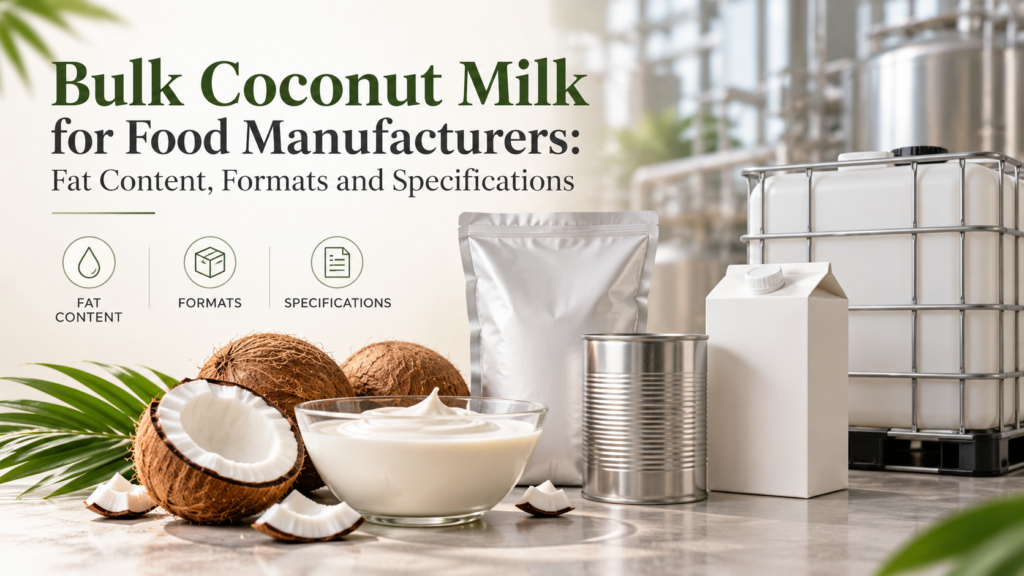
Coconut milk is one of the fastest-growing ingredients in food manufacturing. It is used in dairy-free desserts, plant-based yoghurts, ready meals, curry sauces, soups, beverages, bakery fillings and ice cream. For a manufacturer, though, coconut milk is not a single product. Fat content, format, stabiliser use and certification all change how it performs on the production line and what it costs per finished unit.
This guide explains what food manufacturers should look for when sourcing bulk coconut milk — from fat grades and packaging formats to the technical specifications and certifications to request from a coconut milk manufacturer.
What Food Manufacturers Need from a Bulk Coconut Milk Supplier
Retail shoppers choose coconut milk by brand and price. Food manufacturers choose it by consistency. A recipe developed with one batch must perform the same way with the next hundred batches. That means a good bulk coconut milk supplier must deliver:
- Consistent fat and total solids — so texture, mouthfeel and flavour stay the same from batch to batch.
- The right format for your line — bulk aseptic for in-factory blending, or cans and cartons for food service and retail.
- Full technical documentation — specification sheets, certificates of analysis (COA) and allergen statements for every batch.
- Certifications your customers require — Organic, Fair Trade, Halal, Kosher and BRC are the most common requests.
- Reliable supply and lead times — a missed shipment can stop a production line.
Coconut Milk Fat Grades Explained
Fat content is the single most important specification in coconut milk. It controls richness, viscosity, heat stability and cost. The international reference is the Codex Standard for Aqueous Coconut Products (CXS 240-2003), which groups coconut milk and cream by fat and total solids.
| Product Type | Typical Fat Content | Typical Total Solids | Common Applications |
|---|---|---|---|
| Light coconut milk | 5–7% | 6.6–12.6% | Beverages, plant-based milk drinks, light sauces, soups |
| Coconut milk (standard) | 10–17% | 12.7–25.3% | Curry sauces, ready meals, soups, dairy-free yoghurt |
| Coconut cream | 20–24% | 25.4–37.3% | Desserts, ice cream, bakery fillings, whipped toppings |
| Coconut cream concentrate | 27%+ | 37.4%+ | Confectionery, high-fat dessert bases, cost-efficient shipping |
Note: Ranges are indicative and based on Codex classifications. Always confirm exact specifications with your supplier’s current technical data sheet.
Tip for manufacturers: Higher-fat coconut cream can be diluted in your factory to make several lower-fat products. Buying one high-fat grade can reduce shipping costs (you ship less water) and simplify stock management.
Bulk Coconut Milk Formats: Which One Fits Your Production Line?
The format you choose affects price per litre, storage, handling and shelf life. Here are the main options from a Sri Lanka coconut milk manufacturer:
Bulk Aseptic (Drums, IBCs and Bag-in-Box)
- Pack sizes: 20-litre bag-in-box, 200–220 litre aseptic drums, or 1,000-litre IBCs.
- Best for: Food manufacturers blending coconut milk into sauces, desserts, dairy alternatives and beverages.
- Shelf life: Typically 12–18 months at ambient temperature, unopened.
- Why choose it: Lowest cost per litre, less packaging waste, and easy pumping into production lines.
Canned Coconut Milk
- Pack sizes: 160ml, 400ml, 800ml and 2.9kg catering cans (BPA-free linings available).
- Best for: Food service, restaurant chains, smaller manufacturers and retail private label.
- Shelf life: Typically 24 months at ambient temperature.
- Why choose it: Easy to store and use in smaller quantities; ready for retail shelves.
Cartons and Pouches
- Pack sizes: 200ml–1L Tetra Pak-style cartons and stand-up pouches.
- Best for: Retail brands and drinking-style coconut milk products.
- Why choose it: Lighter than cans and increasingly popular with European and US retailers.
Key Specifications to Request from a Coconut Milk Manufacturer
Before approving a new bulk coconut milk supplier, ask for a full technical specification sheet. These are the parameters that matter most on the production line:
| Specification | Why It Matters |
|---|---|
| Fat content (%) | Controls richness, texture and cost. Ask for the accepted range (e.g. 17–19%), not just a single figure. |
| Total solids (%) | Shows how much coconut is in the product versus water. Affects yield in your recipe. |
| pH | Affects stability and microbial safety. Codex sets a minimum pH of 5.9 for aqueous coconut products. |
| Stabilisers and emulsifiers | Some products contain guar gum, xanthan gum or polysorbate. Clean-label brands often need a “no additives” option. |
| Microbiological limits | Total plate count, yeast and mould, coliforms. Aseptic products should be commercially sterile. |
| Colour and flavour | Should be white to creamy white with a clean coconut taste — no rancid or burnt notes. |
| Shelf life and storage | Confirm shelf life unopened and after opening, plus storage temperature. |
| Allergen status | Coconut is classed as a tree nut in the US (FDA). Labelling rules differ in the EU and UK — confirm for your market. |
Also ask for certificates of analysis for recent batches and, if possible, a pre-shipment sample for trial production. A good supplier will provide both without hesitation.
Certifications That Matter for Bulk Coconut Milk
Your own customers — retailers, brands and food service chains — will often decide which certifications you need. The most requested for coconut milk are:
- Organic (EU Organic / USDA Organic) — required to label finished products as organic in the EU or US.
- Fair Trade — increasingly required by UK and European retailers for own-label ranges.
- BRC Global Standard for Food Safety — the benchmark for UK and European retail supply chains.
- Halal and Kosher — needed for many food service customers and for wider market access.
- Non-GMO and vegan statements — useful for plant-based and clean-label positioning.
Choosing one supplier that holds all of these certifications reduces paperwork and audit work for your quality team.
Why Food Manufacturers Source Coconut Milk from Sri Lanka
- Quality and flavour: Sri Lankan coconuts are known for a rich, clean flavour and naturally creamy texture.
- Vertical integration: Many Sri Lankan manufacturers control the chain from plantation to finished pack, giving better traceability.
- Certification strength: Sri Lankan exporters commonly hold Organic, Fair Trade, Halal, Kosher and BRC certification together.
- EU duty advantage: Under the EU’s GSP+ scheme, eligible coconut milk and cream from Sri Lanka can enter the EU at a reduced or 0% duty rate, subject to correct origin documents.
- Shipping access: Colombo port has regular direct services to Europe, the Middle East, Asia and Australia.
Minimum Order Quantities and Lead Times
Most bulk coconut milk is shipped by sea in full container loads (FCL). A 20ft container typically holds around 18–20 metric tonnes of product, depending on format. Smaller buyers can start with mixed or part-container (LCL) shipments, though cost per unit is higher.
From order confirmation, allow around 6–10 weeks for production, export documentation and sea freight to Europe, and plan longer for first orders that need sampling and approval.
Bulk Coconut Milk from Navik Mills
Navik Mills (Pvt) Ltd is a Sri Lanka-based coconut products manufacturer and exporter supplying food manufacturers, importers and retail brands across 35+ countries. For food manufacturers, we offer:
- Coconut milk and coconut cream in a range of fat grades
- Bulk aseptic, canned and retail-ready formats
- Organic, Fair Trade, Halal, Kosher and BRC certified supply
- Full technical documentation and batch certificates of analysis
- Private label production for your own brand
- Samples available for trial production
Looking for a reliable bulk coconut milk supplier? Contact our export team to request a specification sheet, samples and wholesale pricing. You can also explore our private label coconut products and certifications.
Frequently Asked Questions
What fat content of coconut milk is best for food manufacturing?
It depends on the product. Light coconut milk (around 5–7% fat) suits beverages and light sauces. Standard coconut milk (around 10–17% fat) suits curries, soups and ready meals. Coconut cream (around 20–24% fat) suits desserts, ice cream and bakery fillings. Many manufacturers buy a high-fat grade and dilute it in-house.
What is the shelf life of bulk aseptic coconut milk?
Bulk aseptic coconut milk typically has a shelf life of 12–18 months at ambient temperature when unopened. Once opened, it should be refrigerated and used quickly, following the supplier’s handling guidelines.
What is the minimum order quantity for bulk coconut milk?
The most cost-efficient order is a full container load, typically around 18–20 metric tonnes. Smaller quantities can be arranged through mixed or part-container shipments. Contact Navik Mills to discuss MOQ for your specific product and format.
Can I get coconut milk without stabilisers or additives?
Yes. Many manufacturers, including Navik Mills, can supply coconut milk with no added stabilisers or emulsifiers for clean-label products. Natural separation may occur, so mixing before use is recommended.
Can bulk coconut milk be supplied as organic and Fair Trade?
Yes. Navik Mills supplies coconut milk and cream with Organic and Fair Trade certification, along with Halal, Kosher and BRC. Certificates are available on request for every shipment.
