
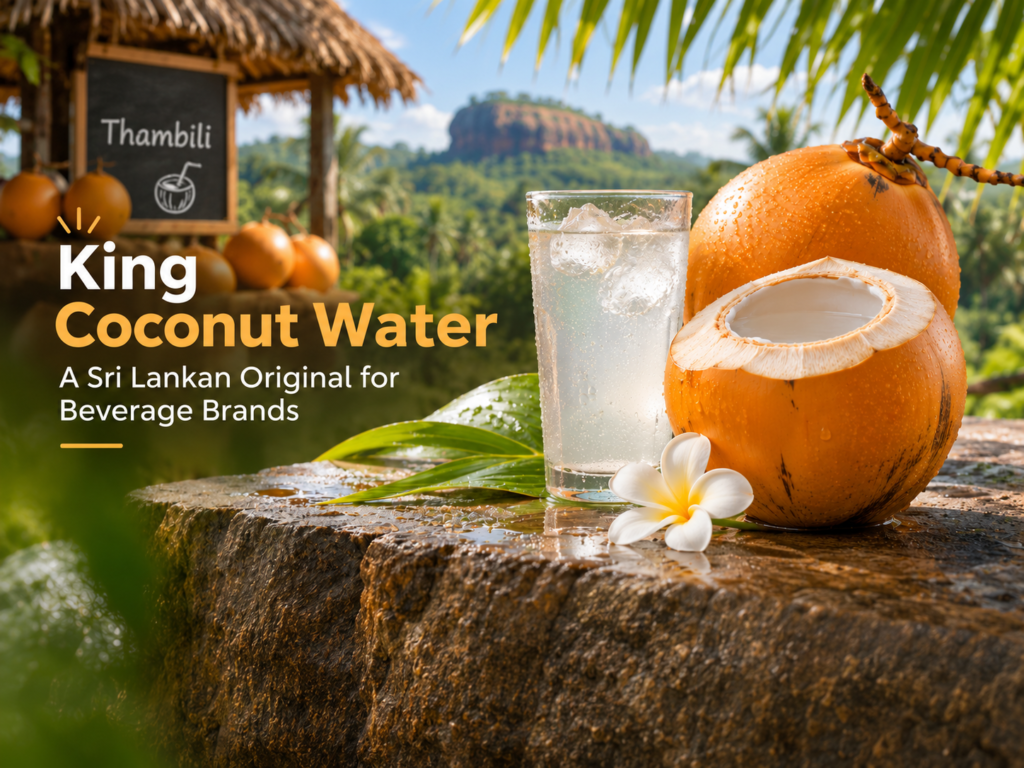
The coconut water aisle is crowded. Most brands source from the same green coconut varieties, from the same few countries, and end up selling products that taste much the same. King coconut water offers beverage brands a way to stand out: a different coconut, a different taste, and a clear origin story rooted in Sri Lanka.
This guide explains what king coconut is, how its water differs from regular coconut water, and what beverage brands need to know before sourcing it in bulk or as a private label product.
What Is King Coconut?
King coconut (Cocos nucifera var. aurantiaca) is a variety of coconut native to Sri Lanka, where it is called thambili. Related forms also grow in parts of India and Indonesia, but Sri Lanka is where the variety is most closely associated, most widely grown and most commercially developed.
It is easy to recognise. King coconuts have a bright orange-golden skin, rather than the green or brown of common coconuts. The palms are shorter than ordinary tall coconut palms and grow across much of the island.
In Sri Lanka, king coconut is the drinking coconut. It makes up the large majority of the country’s tender coconut market, and roadside stalls selling chilled thambili are a familiar sight across the island. King coconut production is almost entirely for its water rather than for its kernel.
King Coconut Water vs Regular Coconut Water
Both are the clear liquid inside a young coconut, and both are naturally rich in potassium. The differences are in taste, origin and the story a brand can tell.
| Feature | King Coconut Water | Regular (Green) Coconut Water |
|---|---|---|
| Variety | Cocos nucifera var. aurantiaca | Mainly tall and dwarf green varieties |
| Main origin | Sri Lanka | Thailand, Philippines, Indonesia, Brazil, India, Vietnam and others |
| Skin colour | Orange-golden | Green |
| Taste | Light, refreshing, gently sweet with a clean finish | Varies widely by variety and origin — from mild to nutty or sweet |
| Brand story | Distinctive, origin-specific, less common on shelf | Familiar, widely available, harder to differentiate |
A note on claims: you will see many health claims about king coconut water online. In most markets, including the EU, UK and US, health and nutrition claims on labels are tightly regulated. Base your label and marketing on the supplier’s lab analysis and on the claims allowed in your market — not on general internet content.
Why Beverage Brands Are Choosing King Coconut Water
1. Real differentiation
Most coconut water brands compete on price and packaging because the liquid inside is similar. King coconut water gives you a genuinely different product with a named variety and a single country of origin.
2. A strong origin story
“Sri Lankan king coconut” is specific, memorable and true. Origin stories like this work well for premium, natural and wellness brands, and they are hard for competitors to copy.
3. Taste
Many consumers who find some coconut waters too salty or too “nutty” respond well to the lighter, cleaner taste of king coconut water. Always run your own taste panels — but it is a strong starting point for brands that want broad appeal.
4. Natural fit with Sri Lankan supply
Because the variety is grown and processed at scale in Sri Lanka, brands can source king coconut water alongside other Sri Lankan coconut products from one supplier, which simplifies logistics and certification.
Harvest Timing and Quality
The quality of coconut water depends heavily on when the nut is harvested. For king coconut, the water is at its best when the nut is young — typically around seven to eight months after pollination. At this stage the water has its best balance of natural sugars and minerals and its freshest taste.
Harvest too early and the water can be thin and lacking in flavour. Harvest too late and the taste changes as the nut matures. A good supplier controls harvest timing, processes nuts quickly after harvest, and checks every batch for sugar level (Brix), acidity (pH) and taste.
Like all coconut water, king coconut water can turn slightly pink after processing. This is a natural reaction of compounds in the water and is not a safety issue, but it can surprise consumers. Ask your supplier how they manage it, and consider explaining it on your pack.
Formats Available
- Bulk aseptic — sterile coconut water in aseptic bags inside drums or IBC totes, for brands that pack in their own country. Shelf-stable without refrigeration until opened.
- Retail-ready — cartons (such as Tetra Pak), cans or bottles, filled and packed in Sri Lanka.
- Private label — retail-ready packs produced under your own brand, with labelling for your target market.
For a full breakdown of processing methods (UHT, HTST and HPP), NFC vs concentrate, and which format suits which brand, see our coconut water sourcing guide for beverage brands.
What to Ask a King Coconut Water Supplier
- Is it 100% king coconut? Ask for confirmation that the product is made only from king coconut and is not blended with other coconut varieties.
- What is the typical Brix and pH? Get the supplier’s accepted range and check it on every certificate of analysis.
- How is it processed? Ask about the heat treatment or preservation method and how it affects taste and shelf life.
- Are there any additives? Many brands want “100% coconut water — nothing added”. Confirm whether any vitamin C, sugar or flavouring is used.
- Which certifications cover it? Check that Organic, Fair Trade, Halal, Kosher or BRC certification applies to this specific product, not just to the company.
- What are the MOQ and lead times? Ask about trial orders, full container loads and how harvest seasons affect supply.
King Coconut Water from Navik Mills
Navik Mills (Pvt) Ltd is a Sri Lanka-based coconut products manufacturer and exporter supplying beverage brands, importers and retailers across 35+ countries.
- Coconut water in bulk aseptic and retail-ready formats
- Private label production with labelling for your target market
- Organic, Fair Trade, Halal, Kosher and BRC certification
- Batch certificates of analysis covering Brix, pH and microbiology
- Samples available for taste panels and product development
Planning a king coconut water launch? Contact our export team for specifications, samples and pricing. You can also read our guide on Fair Trade coconut products if certification is part of your brand story.
Frequently Asked Questions
What is king coconut water?
King coconut water is the water from the young king coconut (Cocos nucifera var. aurantiaca), a variety native to Sri Lanka, where it is known as thambili. It has an orange-golden skin and a light, gently sweet taste.
Is king coconut only grown in Sri Lanka?
King coconut is native to Sri Lanka and is most widely grown and commercially developed there. Related forms are also found in parts of India and Indonesia.
How is king coconut water different from regular coconut water?
King coconut water comes from a different coconut variety with an orange skin. It is known for a light, refreshing taste and a clear Sri Lankan origin, which helps beverage brands stand out from standard green coconut water products.
Why does coconut water sometimes turn pink?
Pinking is a natural reaction of compounds in coconut water after processing. It is not a safety concern, but it can affect appearance. Suppliers manage it through harvest timing and processing control.
Can Navik Mills supply private label king coconut water?
Yes. Navik Mills offers private label coconut water production in retail-ready formats, with packaging and labelling designed for your market. Contact the export team to discuss king coconut water specifically.
