
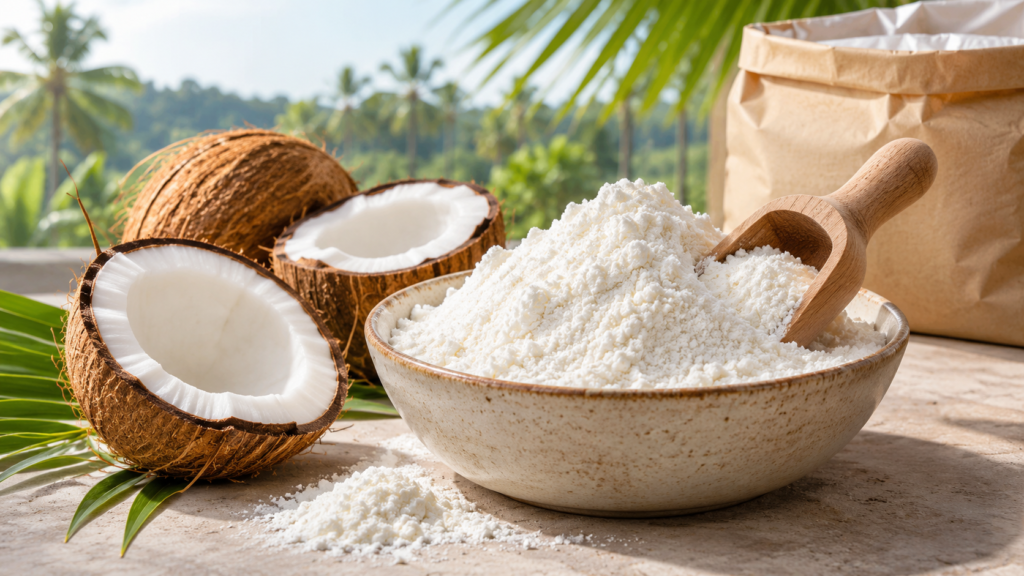
Coconut milk powder gives food manufacturers the taste and richness of coconut milk without the weight, the liquid handling or the short open life. It is light to ship, easy to store and simple to dose into dry mixes. But not all coconut milk powders are the same. Fat level, the carrier used and — most importantly — whether the powder contains milk protein can decide whether it works in your product at all.
This guide explains what coconut milk powder is, the grades you will be offered, what to check on a specification, and how to source it in bulk from Sri Lanka.
What Is Coconut Milk Powder?
Coconut milk powder is coconut milk that has been spray dried. Fresh coconut kernel is pressed to extract milk. The milk is blended with a carrier, usually maltodextrin, and then sprayed into a stream of hot air. The water evaporates almost instantly and leaves a fine, free-flowing powder.
The carrier matters. Coconut milk is very high in fat, and fat on its own does not spray dry well — it turns sticky and clumps. The carrier wraps the fat droplets so the powder stays dry and pours easily. Some grades also use a protein to help with this, which is where the dairy question comes in.
When mixed with water, a good coconut milk powder turns back into a smooth coconut milk. Many manufacturers, however, never add water at all — they use the powder dry in blends.
Where Food Manufacturers Use Coconut Milk Powder
- Dry beverage mixes — instant coffee creamers, latte and chai premixes, protein shakes and smoothie powders.
- Soups, sauces and curry mixes — instant curry kits, ramen and noodle seasonings, cook-in sauce powders.
- Bakery and confectionery — biscuits, cake mixes, fillings and coatings where liquid coconut milk would upset the dough or batter.
- Plant-based and dairy-free products — non-dairy creamers, vegan desserts and milk alternatives (dairy-free grades only).
- Snack seasonings — coconut-flavoured coatings for crisps, nuts and puffed snacks.
The common reason is the same in every case: powder is easier to handle, dose and store than liquid, and it does not add water to a dry product.
The Most Important Question: Dairy-Free or Not?
This is the point that catches out more buyers than any other. Many coconut milk powders on the market contain sodium caseinate, a protein made from cow’s milk. It is added because it helps the powder dissolve and gives a creamier result.
That is fine for a curry mix or a biscuit. It is not fine if your product is labelled vegan, dairy-free or plant-based, or if you sell to customers with a milk allergy. Milk is a major allergen in the US, the EU and the UK, so caseinate must be declared on your label.
| Grade | Contains | Best For | Watch Out For |
|---|---|---|---|
| Standard (with caseinate) | Coconut milk, maltodextrin, sodium caseinate | Curry mixes, bakery, seasonings, general food use | Contains milk — cannot be called vegan or dairy-free |
| Dairy-free / vegan | Coconut milk, maltodextrin or other plant carrier | Vegan creamers, plant-based desserts, allergen-free lines | May dissolve slightly less easily — test in your process |
| Organic | Organic coconut milk, organic carrier | Organic-labelled retail and natural food brands | Every ingredient, including the carrier, must be organic |
Simple rule: always ask for the full ingredient list, not just the product name. “Coconut milk powder” on a price list tells you nothing about what else is inside.
Fat Content: Choosing the Right Level
Fat is what gives coconut milk powder its richness, so it is the main thing that separates one grade from another. Most commercial powders fall somewhere between about 50% and 70% fat.
- Higher fat (around 60–70%) — richer taste and creamier mouthfeel. Good for creamers, desserts and premium curry mixes. Costs more and is more sensitive to heat and storage.
- Lower fat (around 50–60%) — milder flavour, more carrier. Good for seasonings, bakery and price-sensitive products. Usually flows and stores better.
Higher fat is not automatically better. Match the fat level to what your product needs, and confirm the exact figure on the supplier’s specification sheet rather than relying on a general range.
What to Check on a Coconut Milk Powder Specification
Before you approve a supplier, ask for a full product specification and a recent certificate of analysis (COA). These are the points that matter most:
| Parameter | Why It Matters |
|---|---|
| Fat content (%) | Sets richness, cost and how the powder behaves in your recipe. |
| Moisture (%) | Low moisture keeps the powder free-flowing and stops clumping and spoilage. Typically kept very low — confirm the maximum. |
| Solubility | How quickly and fully it dissolves. Critical for instant drinks. |
| Colour and flavour | Should be white to off-white with a clean coconut taste. Yellowing or a soapy taste can mean the fat has started to go rancid. |
| Free fatty acids / peroxide value | Early warning signs of rancidity. Lower is better. |
| Microbiology | Total plate count, yeast and mould, E. coli, Salmonella. Essential for products that are not cooked after mixing. |
| Ingredient list and allergens | Confirms whether caseinate or any other allergen is present. |
Packaging and Storage
Coconut milk powder is usually supplied in multi-layer kraft paper bags with a food-grade inner liner, commonly 20–25 kg. Retail-ready pouches and sachets are available for private label.
Because it is high in fat, the powder must be kept away from heat, light, moisture and strong smells. Store it in a cool, dry place and reseal opened bags tightly. Stored correctly in unopened packs, coconut milk powder typically keeps for around 12 to 24 months, depending on the grade and packaging. Always go by the shelf life stated on the supplier’s specification.
One practical point for importers: high temperatures during sea freight can speed up rancidity in high-fat powders. For long voyages or hot routes, ask your supplier about ventilated or temperature-aware container loading.
Why Source Coconut Milk Powder from Sri Lanka?
- Flavour. Sri Lankan coconuts are known for a rich, sweet, clean coconut taste — which carries straight through into the powder.
- Experience. Sri Lanka has a long history of coconut processing and exporting, and a dedicated national research and regulatory body for the coconut industry.
- Certified supply. Organic, Fair Trade, Halal and Kosher certified options are widely available from established Sri Lankan manufacturers.
- Trade access. Sri Lanka has preferential tariff access to the EU (GSP+) and the UK (DCTS) on many product lines. See our EU import guide for details.
Coconut Milk Powder from Navik Mills
Navik Mills (Pvt) Ltd is a Sri Lanka-based coconut products manufacturer and exporter supplying food manufacturers, importers and retail brands across 35+ countries.
- Coconut milk powder in bulk bags and retail-ready private label formats
- Ask us about dairy-free and organic grades for plant-based and organic product lines
- Organic, Fair Trade, Halal, Kosher and BRC certification
- Full product specification and batch certificate of analysis with every shipment
- Samples available for formulation trials
Not sure which grade suits your recipe? Read our guide on how to choose a certified coconut products supplier, or contact our export team to request specifications, samples and wholesale pricing.
Frequently Asked Questions
Is coconut milk powder dairy-free?
Not always. Many coconut milk powders contain sodium caseinate, a milk protein added to help the powder dissolve. Dairy-free and vegan grades use a plant-based carrier instead. Always check the full ingredient list before using coconut milk powder in a vegan or dairy-free product.
What fat content does coconut milk powder have?
Most commercial coconut milk powders contain between about 50% and 70% fat. Higher-fat grades give a richer taste and are used in creamers and desserts, while lower-fat grades suit seasonings and bakery. Confirm the exact figure on the supplier’s specification.
How long does coconut milk powder last?
Unopened and stored in a cool, dry place, coconut milk powder typically lasts around 12 to 24 months, depending on the grade and packaging. Once opened, it should be resealed tightly and protected from moisture and heat.
How is coconut milk powder packed for bulk export?
Bulk coconut milk powder is usually packed in 20–25 kg multi-layer kraft paper bags with a food-grade inner liner. Retail pouches and sachets are available for private label orders.
Can I buy organic coconut milk powder from Sri Lanka?
Yes. Organic coconut milk powder is available from certified Sri Lankan manufacturers, including Navik Mills. For an organic claim, every ingredient, including the carrier, must be certified organic.
