
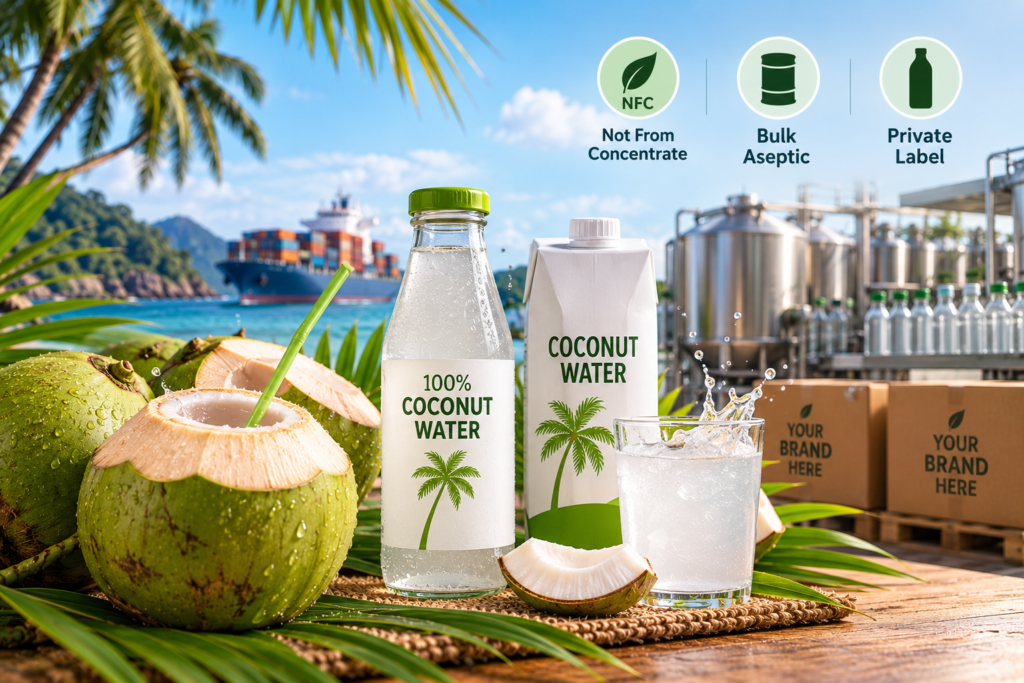
Coconut water is one of the most popular natural beverage ingredients in the world. It is sold on its own, blended with fruit juices, added to sports and hydration drinks, and used in smoothies, cocktails and functional beverages.
For a beverage brand, though, choosing a coconut water supplier is not simple. Processing method, format, taste consistency, certifications and shelf life all affect the finished product and its cost. This guide explains the key choices in plain language, so you can brief suppliers with confidence.
NFC vs From Concentrate: What Is the Difference?
The first decision is whether to buy NFC or concentrate. These two terms appear on almost every coconut water specification.
- NFC (Not From Concentrate): Coconut water is extracted, filtered and treated, but not concentrated. Nothing is removed and then added back. This gives the most natural flavour and is the best choice for “100% coconut water” claims.
- From concentrate: Water is removed from coconut water to make a concentrate, which saves shipping and storage costs. The concentrate is later diluted back to its original strength. It is useful for blends and flavoured drinks, but heat during concentration can change the delicate flavour.
| NFC Coconut Water | Coconut Water Concentrate | |
|---|---|---|
| Taste | Closest to fresh coconut water | Can taste more cooked or sweet |
| Best for | Premium 100% coconut water, clean-label brands | Blends, flavoured drinks, cost-sensitive products |
| Freight cost per litre of finished drink | Higher (you ship the water) | Lower (you ship less volume) |
| Label claim | “100% coconut water”, “not from concentrate” | “Made from concentrate” (labelling rules vary by market) |
Tip: If your brand promises natural, simple ingredients, NFC is usually the right choice. If coconut water is one ingredient among many, concentrate may be enough.
How Coconut Water Is Preserved: Aseptic, Hot-Fill and Cold Processes
Fresh coconut water spoils quickly, so it must be treated to be safe and stable. The method you choose affects flavour, shelf life and storage conditions:
- UHT / aseptic processing: The water is heated very quickly to a high temperature, cooled, and packed in a sterile environment. This gives a long shelf life at room temperature — a major advantage for shipping and retail. Commercial UHT coconut water in retail packs often has a shelf life of several months.
- HTST pasteurisation: A milder heat treatment, usually followed by chilled storage and a shorter shelf life.
- High Pressure Processing (HPP): A cold process that uses pressure instead of heat. It keeps a “fresh” taste but needs refrigeration and has a shorter shelf life. Research on HPP coconut water shows microbial stability for only a few weeks when refrigerated.
For international shipping from Sri Lanka, bulk aseptic is the most practical choice because it survives the long sea journey without refrigeration.
Bulk Aseptic Coconut Water for Beverage Manufacturers
Beverage manufacturers who fill under their own brand usually buy bulk aseptic coconut water.
- Pack sizes: 220-litre aseptic drums and 1,000-litre aseptic IBC totes are common. Other sizes may be available.
- Storage: Ambient temperature, away from heat and sunlight, until opened.
- Shelf life: Depends on processing and packaging, so confirm the exact “best before” with your supplier.
- Use: Pour into your own aseptic filling line for cartons, bottles or cans, or blend into other drinks.
- Why choose it: Lowest cost per litre, full control of your own brand and packaging, and flexibility to create new products.
Retail-Ready and Private Label Coconut Water
If you do not have your own filling line, you can buy finished, branded or private label coconut water from the manufacturer:
- Cartons: 200ml, 330ml, 500ml and 1L aseptic cartons.
- Cans and bottles: Single-serve formats for grocery, convenience and food service.
- Private label programme: The manufacturer supplies the drink, packaging design support, label printing and production under your brand.
A good private label partner will also help with labelling for your market — nutrition panel, allergen statements, country of origin and certification logos.
Quality Specifications to Request
Coconut water is a natural product, so some variation is normal. Ask your supplier for a technical specification sheet that shows the accepted range for each of these:
| Specification | What to Know |
|---|---|
| Brix (natural sugar level) | Usually around 4–6 °Brix for single-strength coconut water. Codex fruit juice guidance references 5.0 °Brix; there is no single worldwide limit, so agree a range with your supplier. |
| pH | Typically around 4.6–5.5 for natural coconut water. Check how it fits with your filling and safety process. |
| Colour and clarity | Clear to very slightly cloudy; no pink or brown colour, which can signal enzyme browning. |
| Taste and aroma | Lightly sweet, clean and fresh; no sour, fermented or “cooked” off-notes. |
| Microbiology | Total plate count, yeast and mould, and commercial sterility for aseptic products. |
| Additives | Confirm whether the product is 100% coconut water with no added sugar, preservatives or flavour. |
| Shelf life and storage | Ask for unopened shelf life, storage conditions and handling after opening. |
Also ask for a certificate of analysis (COA) for every batch and a pre-production sample to taste and test in your own process.
Certifications Beverage Buyers Ask For
- Organic (EU Organic / USDA Organic) — for organic-labelled drinks
- Fair Trade — increasingly important for UK, European and Australian retail
- BRC Global Standard for Food Safety — the benchmark for major retailers
- Halal and Kosher — for wider distribution and food service
- Non-GMO and vegan statements — useful for clean-label brands
One supplier holding all of these certifications reduces your audit work and paperwork.
Why Source Coconut Water from Sri Lanka
- Origin story: “Sri Lankan coconut water” is a strong story for premium brands, and consumers increasingly care where ingredients come from.
- Natural supply: Coconuts grow year-round across the island, supporting steady supply.
- Smallholder farming: Most Sri Lankan coconuts come from smallholder farms, which fits ethical and Fair Trade sourcing needs.
- Certification strength: Leading Sri Lankan exporters combine Organic, Fair Trade, Halal, Kosher and BRC certification.
- Shipping access: Colombo has regular sea services to Europe, the USA, Australia and the Middle East.
Order Quantities and Lead Times
Bulk coconut water is usually shipped by sea in full container loads. A container of aseptic drums or IBCs typically carries around 18–22 metric tonnes, depending on the pack type. Smaller brands can often start with mixed-product containers or smaller trial orders — ask your supplier.
From order confirmation, plan about 6–10 weeks to your port for production, export paperwork and sea freight, and longer for your first order if you need samples and label approval.
For market-specific import rules, see our guides to importing coconut products from Sri Lanka to the USA, importing into Australia and New Zealand, and importing into the EU.
Coconut Water from Navik Mills
Navik Mills (Pvt) Ltd is a Sri Lanka-based coconut products manufacturer and exporter supplying food manufacturers, importers and beverage brands across 35+ countries. For beverage buyers, we offer:
- Coconut water in bulk aseptic and retail-ready formats
- Organic, Fair Trade, Halal, Kosher and BRC certified supply
- Full technical specifications and batch certificates of analysis
- Samples for trial production and taste testing
- Private label production for your own beverage brand
Looking for a reliable coconut water supplier in Sri Lanka? Contact our export team for specifications, samples and wholesale pricing. You can also visit our coconut water page or learn more about private label coconut products and bulk coconut milk for food manufacturers.
Frequently Asked Questions
What does NFC mean for coconut water?
NFC means “not from concentrate”. The coconut water is extracted, filtered and treated, but not concentrated and diluted again. It keeps the closest flavour to fresh coconut water and is the best choice for premium “100% coconut water” products.
What is the shelf life of bulk aseptic coconut water?
It depends on the processing method and packaging. Aseptic coconut water can be stored at room temperature until opened, which makes it suitable for international shipping. Always confirm the exact best-before period with your supplier, and follow their guidance on handling once opened.
What Brix level should coconut water have?
Single-strength coconut water is usually around 4–6 °Brix. Because it is a natural product, the level varies slightly between batches and seasons, so agree an accepted range with your supplier and check it on every certificate of analysis.
Can I buy coconut water as organic and Fair Trade?
Yes. Navik Mills supplies coconut water with Organic and Fair Trade certification, along with Halal, Kosher and BRC. Certificates are available on request for every shipment.
Can Navik Mills supply private label coconut water?
Yes. Navik Mills offers private label production in retail-ready formats, with packaging and labelling designed for your target market. Certifications can be carried through to private label products, subject to certification body requirements.
