
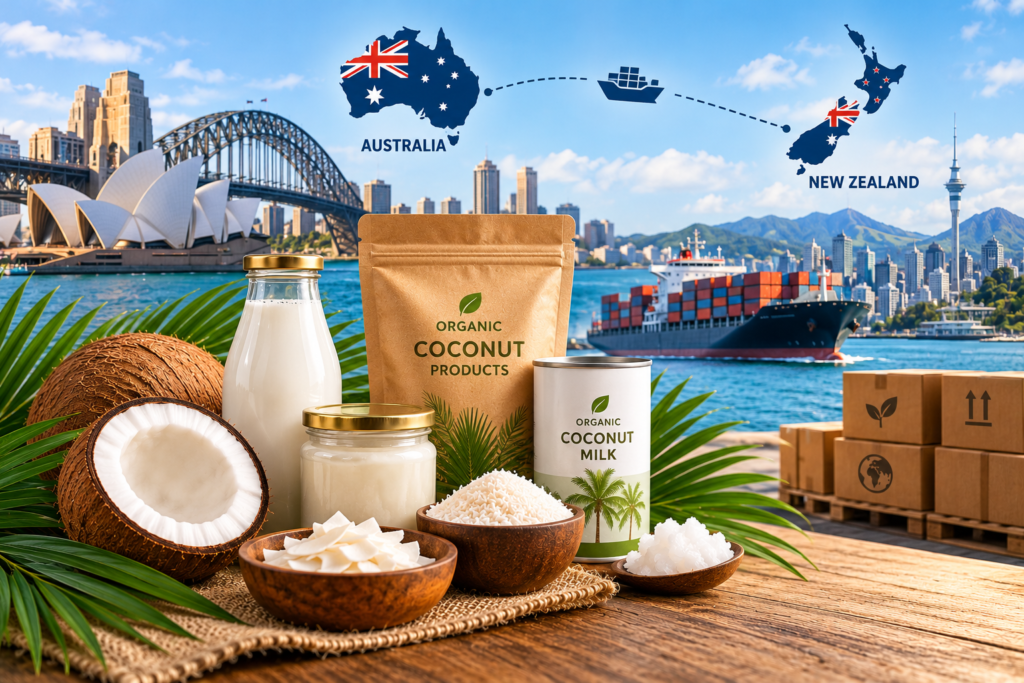
Demand for coconut products in Australia and New Zealand keeps growing. Coconut milk, cream, water, desiccated coconut and virgin coconut oil are now everyday ingredients for food manufacturers, cafés, health food brands and supermarket own-label ranges.
Neither country grows coconuts commercially, so almost all supply is imported. Both countries also have some of the strictest biosecurity rules in the world. This guide explains, in plain terms, what importers need to know to bring coconut products from Sri Lanka into Australia and New Zealand smoothly.
Why Australian and NZ Buyers Choose Sri Lankan Coconut Products
- Quality and taste: Sri Lankan coconuts are known for rich flavour and natural creaminess — ideal for premium retail and food service.
- Shorter shipping than many origins: Colombo has regular sea services to Fremantle, Melbourne, Sydney, Brisbane and Auckland.
- Certification strength: Leading Sri Lankan exporters hold Organic, Fair Trade, Halal, Kosher and BRC certification together.
- Ethical sourcing: Sri Lankan coconuts are harvested by people, mainly from smallholder farms — an important point for ANZ retailers and shoppers who care about ethical supply chains.
- One-stop range: One supplier can provide milk, cream, water, desiccated coconut, oil, flour, sugar and aminos in a single container.
Importing Coconut Products into Australia
Step 1: Check BICON first
All imports into Australia must meet the biosecurity rules set by the Department of Agriculture, Fisheries and Forestry (DAFF). These rules are published in the Biosecurity Import Conditions system (BICON). Imported food safety requirements are now also included in BICON, so it is the single place to check.
For each product, BICON tells you:
- Whether the product can be imported at all
- Whether you need an import permit
- Which documents and declarations must travel with the shipment
- Whether the goods will be inspected or tested on arrival
DAFF has specific import guidance for coconut and coconut meat (including desiccated coconut) and for coconut milk drinks, so check the exact product category in BICON before you order.
Step 2: Food safety inspection on arrival
Imported food is checked under the Imported Food Inspection Scheme. Some foods are treated as higher risk and may be tested more often — for example, dried coconut products can be checked for microbiological safety such as Salmonella. Coconut milk products may also be checked for undeclared allergens, such as dairy milk.
Buyer tip: Ask your supplier for a certificate of analysis (COA) for every batch, covering microbiology and key specs. Good paperwork means faster clearance.
Step 3: Meet the Food Standards Code
Food sold in Australia must meet the Australia New Zealand Food Standards Code, managed by Food Standards Australia New Zealand (FSANZ). This covers ingredients, additives, contaminants and labelling.
Importing Coconut Products into New Zealand
Biosecurity: MPI import health standards
In New Zealand, imports are controlled by the Ministry for Primary Industries (MPI) through Import Health Standards (IHS). Processed coconut products are generally easier to import than fresh coconuts.
- Desiccated (grated) coconut and dried coconut pieces are covered under the rules for processed nut products. Generally, no import permit or phytosanitary certificate is needed, but shipments must be free of pests, soil, weed seeds and other foreign material.
- Fresh coconuts have stricter rules, including phytosanitary certificates.
- Canned and aseptic coconut milk, cream and water are treated as processed foods and must meet NZ food safety rules.
Food safety: register as a food importer
Under New Zealand’s Food Act 2014, any business importing food for sale must be a registered food importer with MPI. Importers must also be able to trace and recall products if there is a safety issue.
Like Australia, New Zealand follows the shared Food Standards Code for most food composition and labelling rules.
Organic and Fair Trade Certification in Australia and NZ
Organic
Australia does not yet have a mandatory national standard for organic products sold within the country. A voluntary standard (AS 6000) is widely used, and in April 2026 the Australian Government committed to developing a mandatory domestic organic framework. In practice, Australian retailers and brands usually want imported organic products certified by a recognised certifier.
New Zealand passed the Organic Products and Production Act 2023, which is bringing in national rules for organic claims. Importers should check the current requirements with MPI.
What this means for buyers: Choose a supplier with internationally recognised organic certification (for example EU Organic or USDA Organic) and ask whether your retail customers need an Australian-recognised certifier such as ACO or NASAA.
Fair Trade
Fair Trade coconut products are popular with ANZ shoppers. Fairtrade Australia and New Zealand runs the FAIRTRADE Mark in both countries, and many retailers and cafés look for it on coconut milk, cream and oil.
Labelling Rules for Retail Products
If you import retail-ready or private label packs, the label must follow the Food Standards Code. Key items include:
- Product name and a clear description
- Ingredient list in descending order by weight
- Nutrition Information Panel (per serve and per 100g/100ml)
- Allergen declarations in the required format (Plain English Allergen Labelling)
- Net quantity in metric units
- Best before or use by date
- Name and Australian or NZ business address of the importer or supplier
- Country of origin — e.g. “Product of Sri Lanka” (Australia has mandatory country of origin labelling for most foods)
An experienced exporter can design and print ANZ-compliant labels as part of a private label programme.
Shipping Routes and Lead Times: Colombo to Australia and NZ
| Route | Approx. Sea Transit Time |
|---|---|
| Colombo → Fremantle (Perth) | 10–16 days |
| Colombo → Melbourne | 16–24 days |
| Colombo → Sydney | 18–26 days |
| Colombo → Brisbane | 20–28 days |
| Colombo → Auckland | 22–32 days |
Transit times are indicative and depend on the shipping line, transhipment ports (often Singapore or Port Klang) and season.
Allow around 6–10 weeks from order confirmation to arrival, including production, export paperwork, sea freight and biosecurity clearance. Plan extra time for your first order.
Import Duties and Taxes
Duties on coconut products entering Australia and New Zealand are generally low, and many lines are duty-free. However, rates depend on the exact tariff code, and import taxes such as GST may apply depending on the product. Always confirm current duties and taxes with a licensed customs broker in Australia or New Zealand before ordering.
Documents to Request from Your Sri Lankan Supplier
- Commercial invoice, packing list and bill of lading
- Certificate of origin
- Certificate of analysis (COA) for each batch, including microbiology
- Organic certificate and transaction certificate, if buying organic
- Fair Trade, Halal or Kosher certificates, if your customers need them
- Food safety certificate, such as BRC Global Standard for Food Safety
- Packing declarations — for example, confirming timber pallets are treated, and containers are clean, to meet biosecurity rules
Coconut Products for Australia and New Zealand from Navik Mills
Navik Mills (Pvt) Ltd is a Sri Lanka-based coconut products manufacturer and exporter supplying food manufacturers, importers and retail brands across 35+ countries. For Australian and New Zealand buyers, we offer:
- Organic, Fair Trade, Halal, Kosher and BRC certified coconut products
- Coconut milk and cream, coconut water, desiccated coconut, virgin coconut oil, coconut flour, coconut sugar and coconut aminos
- Bulk, food service and retail-ready formats
- Batch certificates of analysis to support fast biosecurity clearance
- Private label production with ANZ-compliant labelling
- Mixed-product container loads for smaller importers
Sourcing coconut products for Australia or New Zealand? Contact our export team for specifications, samples and wholesale pricing. You can also explore our certifications and private label coconut products.
Frequently Asked Questions
Do I need an import permit to bring desiccated coconut into Australia?
It depends on the product and its current import conditions. Always check the Biosecurity Import Conditions system (BICON) for your exact product before shipping. BICON shows whether a permit, specific documents or inspection is required.
Do I need a phytosanitary certificate to import desiccated coconut into New Zealand?
Generally no. Desiccated coconut is covered by New Zealand’s rules for processed nut products, which usually do not require an import permit or phytosanitary certificate. The shipment must be free of pests, soil and foreign material, and the importer must be a registered food importer with MPI.
Is organic certification required to sell organic coconut products in Australia?
Australia does not yet have a mandatory domestic organic standard, although the government has committed to developing one. Most Australian retailers still require organic products to be certified by a recognised certifier, so buying from a certified supplier is strongly recommended.
How long does shipping take from Sri Lanka to Australia?
Sea transit from Colombo takes about 10–16 days to Fremantle and around 16–26 days to Melbourne or Sydney. Including production, paperwork and clearance, plan for about 6–10 weeks from order to arrival.
Can Navik Mills supply private label coconut products for the Australian and NZ market?
Yes. Navik Mills offers private label production with labels designed to meet the Australia New Zealand Food Standards Code, including Nutrition Information Panels and country of origin labelling. Organic, Fair Trade, Halal and Kosher certification can be carried through to private label products, subject to certification body rules.
