
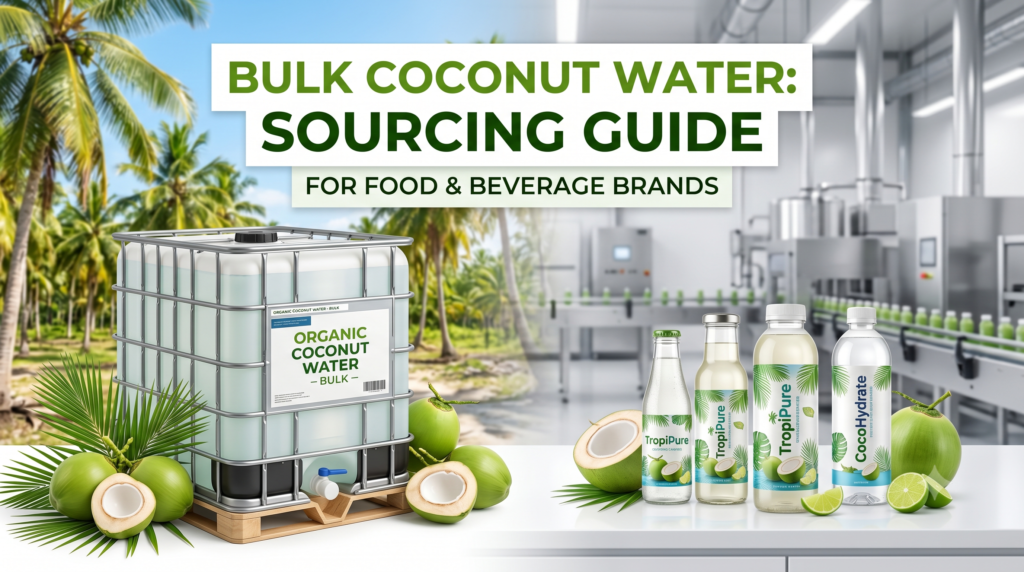
The global coconut water market is projected to exceed $4.9 billion by 2026, driven by consumer demand for natural hydration, clean-label ingredients, and plant-based alternatives to synthetic sports drinks. For food and beverage brands looking to capitalise on this growth, the sourcing decision — where you buy your bulk coconut water, in what format, and from which supplier — determines everything from product quality to shelf life to profit margin.
This guide covers every specification, format, and sourcing consideration that B2B buyers need to evaluate before placing a bulk coconut water order. Whether you are a beverage startup formulating your first RTD product, a food manufacturer adding coconut water to an existing line, or an established brand switching suppliers, this article gives you the technical detail you need to make a confident sourcing decision.
Why Coconut Water Is a Strategic Ingredient for Beverage Brands
Coconut water is no longer a niche health drink. It has become a mainstream functional beverage ingredient used across multiple product categories:
- Ready-to-drink (RTD) coconut water — pure, flavoured, and blended variants for retail shelves
- Sports and recovery beverages — natural isotonic alternative to synthetic electrolyte drinks
- Smoothie and juice bases — clean-label liquid base replacing water or dairy in blended beverages
- Functional food and wellness products — added to protein shakes, wellness shots, and meal replacement drinks
- Cocktail and hospitality mixers — premium natural mixer for bars, hotels, and food service
- Cosmetics and personal care — hydrating ingredient in skincare formulations
The versatility of coconut water as both a finished product and a bulk ingredient makes it one of the most commercially valuable coconut derivatives on the market today.
Bulk Coconut Water Formats: Which One Is Right for Your Operation?
The format you choose for bulk coconut water depends on your production setup, storage capacity, volume requirements, and whether your end product is shelf-stable or refrigerated. Here is a breakdown of the four primary bulk formats available from established suppliers like Navik Mills:
| Format | Volume | Storage | Best For | Shelf Life |
|---|---|---|---|---|
| Aseptic Bag-in-Box | 20 litres | Ambient (room temperature) | Small to mid-scale production, food service, test batches | 12–18 months |
| Aseptic Bag-in-Drum | 200 litres (220 kg) | Ambient | Mid-scale beverage production, industrial blending | 12–18 months |
| Aseptic IBC Totes | 1,000 litres | Ambient | High-volume manufacturing, continuous production lines | 12–18 months |
| Frozen Bulk | Variable (bags/drums) | Frozen (-18°C) | Premium “fresh” positioning, NFC (not from concentrate) products | 18–24 months |
Aseptic vs Frozen: The Key Trade-Off
Aseptic processing (UHT — Ultra-High Temperature) sterilises the coconut water and seals it in a sterile environment, allowing ambient storage without refrigeration. This dramatically reduces shipping and warehousing costs. Most large-scale beverage brands prefer aseptic bulk for this reason.
Frozen bulk avoids heat treatment entirely, preserving the “fresh” taste profile and nutrient density of raw coconut water. However, it requires a cold chain from factory to your production facility, increasing logistics costs. Frozen formats are typically chosen by premium brands positioning their product as minimally processed or “raw.”
Navik Mills offers both aseptic and frozen coconut water in all volume formats, giving buyers flexibility to match their production and positioning requirements.
King Coconut Water: Sri Lanka’s Exclusive Premium Ingredient
If you are sourcing coconut water from Sri Lanka, you gain access to something no other origin can offer: King coconut water.
The King coconut (Cocos nucifera var. aurantiaca) — known locally as Thambili — is a variety exclusive to Sri Lanka. It is not commercially cultivated anywhere else in the world. Unlike standard green coconuts, which are grown for meat, oil, and water, the King coconut is cultivated specifically for the quality and abundance of its water.
King Coconut vs Standard Coconut Water: What B2B Buyers Need to Know
| Parameter | King Coconut Water | Standard Green Coconut Water |
|---|---|---|
| Origin | Exclusive to Sri Lanka | Philippines, Indonesia, Thailand, Brazil, India |
| Husk colour | Bright orange / golden | Green or brown |
| Taste profile | Sweeter, more aromatic, delicate | Mild, slightly nutty |
| Electrolyte density | Higher potassium and magnesium concentration | Good electrolyte profile |
| Calorie content | Very low | Low |
| Primary cultivation purpose | Grown specifically for water quality | Multi-purpose (meat, oil, water) |
| Market positioning | Ultra-premium, origin-exclusive | Mainstream |
| Availability | Sri Lankan suppliers only | Multiple origins worldwide |
For beverage brands targeting the premium and functional drinks segment, King coconut water offers a genuine differentiation story that competitors sourcing from the Philippines or Indonesia simply cannot replicate. The origin exclusivity, superior taste profile, and higher electrolyte density justify a premium price point and support stronger brand positioning.
Navik Mills produces both King coconut water and standard coconut water in organic and Fair Trade certified formats — with flavoured variants including mango, strawberry, lime, lemon, passion fruit, mint, apple, orange, and peach.
Technical Specifications: What to Request from Your Supplier
Before committing to a bulk coconut water supplier, you need to evaluate the product against objective quality parameters. Here are the key specifications every B2B buyer should request and verify:
Core Quality Parameters
| Parameter | Typical Range | Why It Matters |
|---|---|---|
| Brix (°Bx) | 5.0–6.5 | Measures natural sugar content. Higher Brix = sweeter taste. Consistency across batches indicates quality control. |
| pH | 4.5–5.8 | Affects microbiological stability and shelf life. Lower pH = more acidic = naturally more stable. |
| Total Plate Count (TPC) | <10 CFU/mL (aseptic) | Measures microbial contamination. Commercial sterility is critical for coconut water as a low-acid beverage. |
| Yeast & Mould | <1 CFU/mL (aseptic) | Must be undetectable in aseptic formats. Any presence indicates compromised sterility. |
| Colour | Clear to slightly hazy | Browning indicates oxidation or over-processing. Premium buyers expect clarity. |
| Taste / Aroma | Fresh, naturally sweet, no off-notes | Cooked or caramelised taste indicates excessive heat treatment. |
Documents to Request Before Ordering
- Certificate of Analysis (COA) — batch-specific lab results covering Brix, pH, micro, and sensory evaluation
- Product specification sheet — detailed ingredient list, allergen declaration, nutritional panel per 100mL
- Certification copies — current BRC, organic (USDA NOP / EU Organic), Fair Trade, Halal, Kosher certificates with expiry dates
- Shelf life study — documented stability testing confirming stated shelf life under specified storage conditions
- Traceability documentation — ability to trace product back to harvest origin, extraction date, and processing batch
Flavoured Coconut Water: Expanding Your Product Line
Pure coconut water is the foundation — but flavoured variants are where many brands find their competitive edge. The global market is seeing strong growth in coconut water blended with fruit flavours, functional ingredients, and botanical extracts.
Navik Mills currently produces the following flavoured coconut water variants in both King coconut and standard coconut water bases:
| Flavour | Format | Certification |
|---|---|---|
| Coconut Water with Mango | Canned, glass jar, aseptic | Organic, Fair Trade |
| Coconut Water with Strawberry | Canned, glass jar, aseptic | Organic, Fair Trade |
| Coconut Water with Mint | Canned, glass jar, aseptic | Organic, Fair Trade |
| Coconut Water with Orange | Canned, glass jar, aseptic | Organic, Fair Trade |
| King Coconut Water with Lime | Canned, glass jar, aseptic | Organic, Fair Trade |
| King Coconut Water with Lemon | Canned, glass jar, aseptic | Organic, Fair Trade |
| King Coconut Water with Passion Fruit | Canned, glass jar, aseptic | Organic, Fair Trade |
| King Coconut Water with Apple | Canned, glass jar, aseptic | Organic, Fair Trade |
| King Coconut Water with Peach | Canned, glass jar, aseptic | Organic, Fair Trade |
For brands with custom formulation requirements, Navik Mills also offers private label and white label programmes — including R&D support for new flavour development, custom Brix and pH targeting, and packaging design assistance.
Certifications That Matter for Coconut Water Sourcing
Coconut water is a low-acid beverage, which makes food safety certification particularly critical. Retail buyers and distributors in Europe, North America, and Japan will require documented proof of compliance before listing your product. Here are the certifications your supplier must hold:
- BRCGS (Grade A or AA) — mandatory for UK and major European retail chains. Non-negotiable for Tesco, Sainsbury’s, Aldi, Lidl, Carrefour supplier qualification.
- USDA NOP Organic — required to make organic claims in the United States and Canada.
- EU Organic (EC 2018/848) — required for organic claims in the European Union.
- Fair Trade — increasingly expected by European retailers and conscious consumers. Navik Mills’ coconut water range is fully Fair Trade certified.
- HACCP / FSSC 22000 — food safety management system certification that underpins all other compliance.
- Halal & Kosher — essential for Middle Eastern export and specific retail channels in Europe and North America.
Logistics and Shipping Considerations
Bulk coconut water is a sensitive product that requires careful logistics planning. Here are the key considerations for B2B buyers:
Aseptic Products (Ambient Shipping)
- Can be shipped in standard 20ft or 40ft dry containers
- No refrigeration required during transit — significant cost saving vs frozen
- Typical transit time from Sri Lanka to EU ports: 14–21 days; to US East Coast: 25–30 days
- Palletised loading for easy warehouse handling
Frozen Products (Cold Chain Required)
- Must be shipped in reefer (refrigerated) containers at -18°C
- Higher freight cost — typically 40–60% more than ambient shipping
- Requires frozen storage at your receiving warehouse
- Best suited for premium brands where the “fresh” positioning justifies the logistics premium
MOQ Guidance
Minimum order quantities vary by format. As a general guide for Sri Lankan suppliers:
- Aseptic Bag-in-Box (20L) — typically 1 x 20ft container (varies by supplier)
- Aseptic Drums (200L) — typically 80 drums per 20ft container
- Aseptic Totes (1000L) — typically 20 totes per 40ft container
- Canned retail (330mL / 500mL) — typically 1 x 20ft container (~1,500–2,500 cases)
For exact MOQ and pricing, contact Navik Mills directly with your volume requirements and target market.
How to Choose the Right Coconut Water Supplier
Not all coconut water is created equal, and not all suppliers operate to the same standard. Here is a practical supplier evaluation framework for B2B buyers:
- Is the supplier a manufacturer or a trader? Manufacturers who control their own processing facility (like Navik Mills) offer better quality control, traceability, and pricing than trading intermediaries.
- Do they offer both King coconut and standard coconut water? Having access to both gives you flexibility to serve premium and mainstream market segments.
- Can they provide aseptic AND frozen formats? A supplier with both capabilities can support your product evolution as your brand grows.
- Is their certification stack complete? BRC + Organic + Fair Trade + Halal + Kosher = maximum market access from a single source.
- Do they support private label? If you’re building your own brand, you need a supplier who can produce under your label with custom formulations.
- Can they provide batch-level COAs? Every shipment should come with documented lab results. No exceptions.
- What is their track record in your target market? Ask for references from existing B2B customers in your region.
Conclusion: Securing Your Coconut Water Supply Chain
Bulk coconut water sourcing is a technical procurement decision that directly impacts your product’s taste, safety, shelf life, certification compliance, and profitability. The format you choose, the specifications you require, and the supplier you partner with all need to be aligned with your production capacity and market positioning.
Sri Lanka — and specifically Navik Mills — offers B2B buyers a unique combination: access to exclusive King coconut water, full organic and Fair Trade certification, aseptic and frozen bulk formats across all volume tiers, and a vertically integrated manufacturing operation with over 300 products and exports to 55+ countries.
Request Bulk Coconut Water Pricing →
Frequently Asked Questions
What is the difference between King coconut water and regular coconut water?
King coconut (Thambili) is a variety exclusive to Sri Lanka with a bright orange husk. Its water has a naturally sweeter, more aromatic taste and higher concentrations of potassium and magnesium compared to standard green coconut water. King coconut is cultivated specifically for its water quality, making it the premium choice for beverage brands targeting the functional and wellness market.
What bulk formats are available for coconut water?
Bulk coconut water is available in four primary formats: aseptic bag-in-box (20L), aseptic bag-in-drum (200L), aseptic IBC totes (1,000L), and frozen bulk. Aseptic formats are shelf-stable at ambient temperature for 12–18 months, while frozen formats preserve the raw taste profile and have an 18–24 month shelf life at -18°C.
What certifications should a coconut water supplier have?
At minimum, look for BRCGS (food safety), USDA NOP and EU Organic (organic compliance), HACCP or FSSC 22000 (food safety management), and Fair Trade (ethical sourcing). For specific markets, Halal and Kosher certification may also be required. Navik Mills holds all of these certifications.
Can I get private label coconut water from Sri Lanka?
Yes. Leading Sri Lankan manufacturers like Navik Mills offer full private label and white label programmes. This includes custom formulation, custom Brix and pH targeting, flavour development, label design support, and packaging in cans, glass jars, Tetra Pak, or bulk aseptic formats under your brand name.
What is the minimum order quantity for bulk coconut water?
MOQs vary by format and supplier. Typical minimums are one 20ft container, which equates to approximately 80 drums (200L each) or 20 totes (1,000L each) for bulk aseptic formats. For retail-packed canned coconut water, a container typically holds 1,500–2,500 cases. Contact your supplier directly for exact figures and pricing.
